Friday, 10 November 2017

Novena for the Fallen Through ~ our seventh prayer for our wild kin


Here is the seventh of our November Novenas for the Fallen Through, which for this month are devoted to Saint Cuthbert and to a call for protection for our wild kinfolk. If you would like to read more about this month’s novena you can read our first prayer here.

We have already lifted prayers for our badgers, our hedgehogs, and for the street trees of Sheffield, for otter, cormorant, and seal, and for sharks and orcas, and for stag beetles. Today, as yesterday, we will weave prayer around another being who we can support with our gardens, the starling.

Living a life of quiet contemplation in the wild landscape of Inner Farne, St Cuthbert shared many intimate moments with birds. I written before about his great love for eider ducks, who inspired him to introduce perhaps the world’s first bird conservation laws in 676, and who are now known as ‘Cuddy ducks’ in the local area. In one story about him told by Bede, he was said to have set out on one of his long journeys and took a young boy with him for company. It was a long day of walking in a difficult terrain and the boy became tired and hungry, worrying that they had nothing to eat. Cuddy told him not to be concerned and that God would provide. Soon afterwards they saw an eagle flying overheard and Cuddy said that food would be brought to them by the wild bird. After a while they saw the eagle settled by a riverbank. Cuddy instructed the boy to run over to see what had been brought for them and, when he did so, he found a large fish left on a rock. When he saw what the boy had brought back, Cuthbert admonished him for not leaving any food for the eagle and instructed him to cut the fish in half and return part of it to their helper.


On another occasion, a group of ravens flew down and began to gather straw from the thatch of Cuddy’s roof. He chased them away but three days later one returned as he dug his garden and bowed its head to him with wings outspread. Cuthbert told the raven that they were welcome to return and on their next visit they brought with them the gift of a lump of lard, which Cuddy kept and encouraged visitors to use for the purpose of waterproofing their shoes. There have been many reports of corvids bringing gifts to people who have woven right relationship with them and so this story feels to hold many layers of beautiful truth. I also love the stories of our wild edge early Christian saints, so many of which are grounded in respect and sharing with non-human family. Truly a woven sacred.

Starling, Wiki Commons

Starry-winged starlings, so beautiful of feather and bright of spirit, are one of our most familiar, and seemingly abundant, garden birds. It might then shock many of us to know that their numbers dwindled by 80% in the British Isles between 1966 and 2004 , with a 92% drop in woodland populations, and that they are now on the Red List for Birds of Conservation Concern. I was born in 1966 and so writing this I feel that I have spent my whole life in the presence of a dying star.

Starlings truly are the most beautiful of birds; the juveniles have grey~brown plumage, with large white speckles on their chests and creamy throats. In the autumn they moult completely and take in the adults’ stunning colours; black twinkling with snowflake white in the winter and, as the year turns to spring, becoming iridescent green and purple. Even their beaks change colour, from dark brown in winter to yellow in the spring and summer, with a blue base for males and pink for females. They will feed on almost anything; insects, worms, fruits, berries, scraps, and suet, although they will feed only invertebrates to their young. Bringing them up proper!

Starling and fledgling, Ian Dunster, Wiki Commons

They also have a beautiful sense of the division of labour, with the unpaired males building a nest base from grass in cavities in walls, trees, or buildings, which they may then decorate with leaves and petals in order to deter parasites and improve their chances of attracting a mate. Once prepared, they will sing from a perch close to the nest entrance hoping to open the heart of a female. Once entranced and enamoured, the female will complete their home by creating a nest cup, which she then lines with feathers, wool, and moss. In April they will lay 4 to 6 eggs, which will be almost exclusively incubated and brooded by the female, with the fledglings being fed by both parents. Which is just as well as I have seen how demanding the babies can be!

Jason Spinks, Wiki Commons

Despite their intricate nest-building they are born wanderers and, once the juveniles have become independent, they will disperse in large flocks, probably to farmland or woodland. We have seen this in our own garden, where summer days are filled with a noisy cacophony of starlings, only to suddenly fall silent at the turning to autumn. That is always a sad day, although they aren’t gone for long. As autumn goes on they, together with overwintering migrants from Scandinavia, Finland, and Poland, return to begin their wild song once more, a song whose gift for mimicry has been noted by Pliny the Elder, William Shakespeare, and in the earliest recorded prose stories in the literature of Britain, The Mabinogian.

During the winter, these birds gather in buildings, trees, or reed beds to create roosts, often several thousand birds strong. The reed bed roosts though can comprise several million birds, which provide individuals with protection from predators, and it’s these which create the wonderful spectacle of murmurations as they return to settle for the night. I remember seeing a tiny murmuration of starlings flying above a shopping centre in Thamesmead, South London, which I rejoiced in until I realised that they were there because the land had once been a wetland of reeds and that they continued to return to that place turned to concrete and desolate-dry. I couldn’t quite bare to look at them after that. I did though love to spend time with the cheeky little starlings of Woolwich, who would splash about in the water feature there and fearlessly run between people’s legs on the busy pavement seeking out crumbs. I’m not sure that many people bothered even to glance at them, so familiar are they. Often I felt that, even in that most manic of places, the starlings and I had shared a moment that was ours alone. They helped me keep going on many dark days. I was a little afraid of them when I was young, I think that it was the sharp rapier of their beaks that disturbed me. Now I feel nothing but gratitude and love.

A Wedge of Starlings, Walter Baxter, Wiki Commons

As for their survival in our land, it is sad to note that, whilst one third of starlings used to survive their first year, this number has now been reduced to only 15%. Birds surviving to breeding age may live for a further two to three years, although the oldest known individual was 21 years old! Starlings are tenacious and adaptable birds and their fortunes are closely linked to human activity, particularly as farming has provided them with suitable conditions for nesting. It is people who have made it possible for starlings to hugely increase their numbers across Europe and Asia, so deeply woven in are we. In many countries, they are considered beneficial as, by eating large numbers of invertebrates which are considered crop pests, they do us a service. However, in areas where autumn and winter crops are grown, they may come into conflict with people. These conflicts mainly centre on cherry orchards (I know that they strip our cherry trees every year, but I celebrate that, along with any cherries that I manage to salvage for myself!), autumn-sown cereal crops, and cattle feeding troughs. Because of this there have been many failed efforts to reduce their numbers.

In Britain though that decline seems to be happening whether we have a direct hand in it or not, and it’s not entirely clear why. It’s likely that rural populations are being adversely affected by loss of permanent pasture, which is their preferred feeding habitat, together with an intensification of livestock rearing. It may also be that their dependence on invertebrates when feeding their chicks has made them vulnerable as that food source becomes more scarce due to climate change and the use of pesticides. They may also be finding fewer suitable sites for nesting owing to household improvements, so hermetically sealed are we. Often too they are disliked even by people who enjoy feeding birds in their gardens, due to their clearing a bird feeder in a matter of minutes. I can certainly attest to that, as we seemed to spend more money replenishing the birds’ food over the summer than we did our own! Starlings are gregarious birds and have evolved to feed in flocks for protection, but they are nonetheless labelled ‘greedy’ by some. This is easily remedied if one must by providing some feeders that are only accessible to smaller birds.

It is clear that the fortunes of human and starling are deeply entwined. I hope for more sustainable farming practices that might help them, and us, to thrive and I hope that, as with stag beetles, we can use our small plots of earth, our gardens, to help the starling people survive. It seems that they are most affected by the reduction in numbers of worms and other invertebrates when they are feeding their babies. At all other times they are so deeply adaptable and resilient, very much like humankind, and so perhaps we could again be more mindful of allowing our gardens to become a prayer to dirt, encouraging a diversity of beings to make their homes there. I know that that would be a world that wasn’t just more healthy for starlings and their young, it would be more beautiful for us. Certainly this year the starling people in our garden seem to have successfully raised two clouds of young and it has been a joy to see. I am just a little bit proud if anything that we have done has helped them. Bring on the cacophany of feathers and stars!

The Starling That Dared to be Different, http://www.radiolab.org/story/starling-dared-be-different_kw/

Novena for the Fallen Through

Protection, justice, and shining health for our wild kin.

This is a prayer is for the starling people, our starry-sky kin.

Blessed Cuthbert,
Beloved Cuddy,
Saint of Salt and Fire,
Antlered ancestor,
Friend of otter, eider, cormorant, and crow,
Walker of the untamed edge of Land and Spirit,
Lover of wild places, wild creatures, and wild grace,
Threader of sea-stars into wild prayer.

We stand in solidarity with you at the roots of the Tree of Life.

We lift a prayer of solidarity and hope for our the starling people,
beautiful of feather, bright of spirit, wild of voice,
from winter speckled snowflakes to summer Northern Lights,
trailing spring in their Aurora Borealis flight.

Blessings on the starling people,
so deeply entwined with the tides of humankind,
adapatble, resilient, communal, vociferous,
so much like us, so beautifully different.

Blessings on the rakish ones,
the rowdy ones,
the raucous ones,
breakers of monotony,
who split the day with song.

Blessed Cuthbert,
Beloved Cuddy,
Saint of Salt and Fire,
Antlered ancestor,
Friend of otter, eider, cormorant, and crow,
Walker of the untamed edge of Land and Spirit,
Lover of wild places, wild creatures, and wild grace,
Threader of sea-stars into wild prayer.

We stand in solidarity with you at the roots of the Tree of Life.

Help us to learn from the star-feather people
the meaning of home,
the strength of base and cup, of nest and love,
the tenderness of shared work,
the vulnerability of trust.

Help us to honour that
the foundations of our homes may be built
in a different prayer;
the ghosts of reed beds, marshes, rivers, streams,
woodland, the dream of trees,
to remember that there are other needs than ours,
built in deeper tides and times.
Help us to allow and provide what we can
to make a home for all beings displaced
by our own ancient quest for home.

Help us to remember that
cracks don’t mean crumbling,
but can be the space where Life gets in.

Blessed Cuthbert,
Beloved Cuddy,
Saint of Salt and Fire,
Antlered ancestor,
Friend of otter, eider, cormorant, and crow,
Walker of the untamed edge of Land and Spirit,
Lover of wild places, wild creatures, and wild grace,
Threader of sea-stars into wild prayer.

We stand in solidarity with you at the roots of the Tree of Life.

Teach us how to share, to joyfully give,
to learn that self-protection can appear as brashness,
that seeming greed is often need.
Help us learn to live communally,
cooperatively, collectively
as you did with your own wild kin,
became a joyous choir of diversity,
singing the mending of relationship in.
To mimic your older tongue,
a way of living that we have forgotten for so long.

And let our little starlings,
our pearly kings and queens,
lead the choir with boisterous symphony.

Help us to notice what the earth gives freely,
where we stop the flow of mother’s milk
by being too tidy, too attached to our plans
for land that is only borrowed and gifted to our care.
Help us to learn from the starling people
the ability to change our colours and our seasons,
not being fixed, adapting to what comes,
allowing our gardens to take their own shape,
embracing spider and cranefly, moth and mayfly,
snail and earthworm, sawfly and bee,
a feast for starling chicks,
bringing the wild to door and heart,
and finding both flung open.

Blessed Cuthbert,
Beloved Cuddy,
Saint of Salt and Fire,
Antlered ancestor,
Friend of otter, eider, cormorant, and crow,
Walker of the untamed edge of Land and Spirit,
Lover of wild places, wild creatures, and wild grace,
Threader of sea-stars into wild prayer.

We stand in solidarity with you at the roots of the Tree of Life.

We lift a prayer of sorrow
for the dwindling of the starling people,
the silencing of their song,
we do not wish to live in a world of dying stars,
but in a nursery of light.

We pray for their return,
for soft nests and warm spring rains,
for untainted earth rich with life,
for long summers and wide blue skies,
for golden autumn, the intimacy of winter
for discordant song to fill the air with joy,
as speckled snow and northern light,
teach us how to live more deeply entwined.

We ask this in the name of badger and water vole,
hen harrier and natterjack toad,
red fox and red deer,
dotterel and dormouse,
red squirrel and seal.

Of starling and sparrow,
sand lizard and slow worm,
hedgehog and hare,
corn marigold and marsh cleaver.

Of great crested newt and small fleabane,
ringed plover and oystercatcher,
pasque flower and mountain ringlet butterfly,
wildcat and skylark.

Of marsh fritillary butterfly and shrill carder bee,
blue ground beetle and white-clawed crayfish,
freshwater pearl mussel, cormorant, and crow.

Blessed Cuthbert,
Beloved Cuddy,
Saint of Salt and Fire,
Antlered ancestor,
Friend of otter, eider, cormorant, and crow,
Walker of the untamed edge of Land and Spirit,
Lover of wild places, wild creatures, and wild grace,
Threader of sea-stars into wild prayer.

We stand in solidarity with you at the roots of the Tree of Life.

May the starling kin thrive.
In a human world where so many walk with loneliness,
let them teach us the value of good company
the protection of community,
the joy of dancing in constellation,
and may humankind and starlingkind
become celestial family,
a twinkling stellar society,
find that our futures are entangled,
that it’s written in our stars.

The first is for badger.
The second is for hedgehog.
The third is for Sheffield’s street trees.
The fourth is for otter, cormorant, and seal,
for salmon, and elver, and eel.
The fifth is for shark and orca,
the sixth for stag beetle,
the seventh for starling.
May our string of prayer beads,
formed in the starry sea where all things are one,
gathered on the shore of meeting,
be filled with life, love, and wild justice
for all beings on this earth we share.

For this we pray.

Aho mitake oyasin, amen, blessed be. Inshallah.


Starling at Stonehenge, R Wampers, Wiki Commons

Information and References:


Novena for the Fallen Through ~ our sixth prayer for our wild kin


Here is the sixth of our November Novenas for the Fallen Through, which for this month are devoted to Saint Cuthbert and to a call for protection for our wild kinfolk. If you would like to read more about this month’s novena you can read our first prayer here.

We have already lifted prayers for our badgers, our hedgehogs, and for the street trees of Sheffield, for otter, cormorant, and seal, and for sharks and orcas, all of whom I’m sure would have been familiar to St Cuthbert who spent so much time with the sea. Today, we turn away from the water and the wild edge of things to a quite spectacular antlered being whose greatest UK stronghold is in South and West London; the stag beetle. As Cuddy first appeared to me with antlers in a dream I think that he might quite like them!

Male stag beetle, Suffolk Wildlife Trust

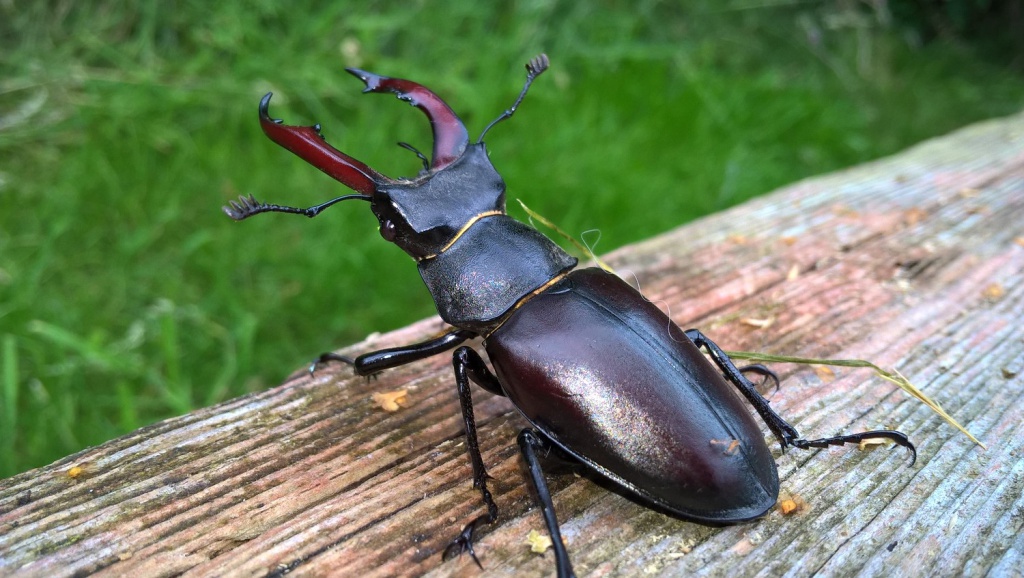
The stag beetle, also known as a horse pincher, thunder beetle, and oak ox, is the largest beetle in the UK and is protected under the Wildlife and Countryside Act 1981, together with being classified as a Priority Species in the UK Biodiversity Action Plan. Its larvae depend on old trees and rotting wood to live and feed on and their favourite habitat is oak woodland, but they can also be found in gardens, parks, and hedgerows. The majority of their lifespan is spent as larvae, which can take between three to seven years to develop before they pupate and transform into adults. In contrast to this long, slow journey, the adults emerge in May with the sole purpose of mating and die in August once eggs have been laid. I can’t help now thinking of the adults as fireworks. All that time in the dark heart of the wood and then a brief whooosh before falling back to earth!

Stag beetle larva, Daily Mail

Stag beetle, Holborough Marsh, truewildlifeblogspot.com

We are most likely to see stag beetles when the beautifully burnished~chestnut males fly on warm summer evenings in search of a mate, or perhaps when they are gathering strength by basking in the sunshine during long summer days. Once they find a female they display their antler-like jaws to her and then use them to fend off rival males, in much the same way that deer stags would do. I love that the ‘way of the deer’ is being played out in layer after layer of life. I was also delighted to find that many of the common names for stag beetles around the world relate to deer. To name a few, in Belgium they are called ‘grande biche’, or ‘great doe’, in Norway they are ‘eikhjort’, or ‘oak deer’, in France they are ‘cerf-volant’, and in Italy ‘cervo-volante’, both translated as ‘flying deer’, in Bosnia they are ‘jelenjak’ and in Macedonia, ‘Elenche’, both meaning ‘little deer’. I am sure that antlered St Elen is watching over these little beetles, just as she does her reindeer and deer.

Stag beetle male & female by Ross Bower for PTES

Interestingly, in Germany, and to some extent in England, they seem to be more often linked with fire, revealing what may be some of their oldest names; ‘feuerschröter’, or ‘fire thresher’, ‘hausbrenner’, or ‘house burner’ (relating to the old superstition that stag beetles came to fires in order to take some to burn down houses), feueranzünder, or ‘fire lighter’, and ‘donnerpuppe’, or ‘thunder puppet’, from the belief that stag beetles were the holy animals of the God of Thunder. These beliefs are also found in England, where it was once said that they could summon lightning or carry a burning coal in their jaws to ‘do the Devil’s work’. I am not so sure about that, remembering that so many holy animals are later demonised, but I am sure that St Cuthbert, who was also known as the ‘Fire of the North’ might have felt much kinship with these small beings. I myself was delighted to find that one of their names in Kent where I live is ‘cherry-eater’!

Image: PTES

As I mentioned above, South and West London provide a vital refuge for our threatened stag beetles. They can also be found elsewhere in southern England, in the Severn Valley, and in coastal areas of the southwest. Elsewhere in Britain they are extremely rare or even extinct. There are several threats to their survival. The rarely seen female stag beetles prefer light soils where they can more easily dig down and lay their eggs. Their larvae spend most of their life below ground, often at depths of up to half a meter. When they emerge as adults they need to be in an environment that allows them to dig their way to the surface. Aside from this they prefer warm areas with low rainfall, and so rain-increasing climate change may prove a challenge for our small stags, with very dry weather adversely affecting the survival of larvae. Their food sources are also becoming harder to find. Female beetles are able to fly but spend most of their lives walking about on the ground until they have mated, which is when they attempt to return to their own birthing ground. If there is enough food there she will then lay her eggs underground in rotting wood, such as log piles, tree stumps, and old fenceposts. The larvae feed on this decaying wood below ground, but it is becoming scarce as many of us become more and more obsessed with having tidy gardens. The adults are unable to eat solid food and rely on fat reserves built up during their larval stage. They are though partial to sipping sap and fallen soft fruit. One of my favourite places in Glastonbury is the Abbey Orchard, where the fruit is often left to fall and rot. I find that process beautiful but remember taking a friend there expecting him to find it beautiful too. Instead, he bemoaned the ‘waste’ of the uncollected apples, found it an ugly, uncared for place. It is a sad world indeed where we see the worth of something only when it is obviously useful to, or wanted by, ourselves. It would be a blessing to the earth indeed if we could shift our way of thinking to see grace in allowing the falling and return of the standing people and their fruits which are of such value to the wild web of life. I very much doubt that those rotting apples were wasted and I’m sure that stag beetles would have loved them.

Fallen apples, Jacqueline Durban, August 2017

Stag beetles are also under threat from predation by cats, foxes, crows, and kestrels, who are able to kill them when they are vulnerable above ground in their adult stage. But the most significant risk to their survival is from habitat loss. Many of Britain’s woodlands were sold for development between the wars. Although the introduction of the Green Belt in 1947 provided some protection, many open spaces in the south-east have now been overdeveloped without giving proper consideration to maintaining wildlife habitat. This despite their legal protection stating that, if stag beetles or their larvae are thought to be present on a site marked for development and they might be disturbed, it is recommended that someone with expert knowledge of their habitat needs is present to make sure that they are suitably relocated nearby. But relocated to where!? In addition the ‘tidying’ of green spaces and the tree surgery practice of ‘stump grinding’ felled and fallen trees has meant that there is little wood left able to rot.

Delicious stag beetle friendly fence post, September 2017

But we should not be too downhearted as increasing awareness has meant that many green spaces, particularly in London, now have a policy of retaining areas of dead wood with the specific aim of attracting stag beetles. I think that one of my favourite scenes in the BBC televsion series ‘Twenty Twelve’, which satirised London’s preparations for the Olympics, was when a meeting was held between the Head of Sustainability and someone from a stag beetle protection group who had visited the Olympic offices to advocate for dead wood being retained in Greenwich Park. He was assured that the organisers had carefully collated a map of all the tree stumps in the Royal Park with a view to retaining them only to find that the marks on the map were wastebins!

Sadly, stag beetles are also directly under threat from us. I have seen two stag beetles in my life, both in South London. One, gloriously, was seen flying in a warn summer evening when I had gathered with a group for a bat walk. I can tell you that we quite forgot the bats, wonderful though they are, when the sight of a whirygig male stag beetle came into view. I thought that he must have been a fairy! The other one was, tragically, squashed on a London pavement. Warmth-loving stag beetles are attracted to tarmac on pavement and road surfaces during the summer and, of course, there they are vulnerable to feet and traffic. Sometimes they are also killed because they ‘look dangerous’, even though stag beetles are very, very rarely aggressive to humans (although if you do ever get into an argument with one then it might be handy to know that it’s the smaller females who have the most powerful jaws!).

Stag beetle female by John Hallmen on Flickr

Despite this, what I do find lovely about the relationship between humans and stag beetles, is that they offer us such an opportunity to offer help and support. In so many ways their proximity to ordinary people holds the key to their continued survival, revealing to us the shimmering web of right relationship that is possible between us and our wild kin. Every year we are becoming more attuned to the needs of our companion stag beetles and they are increasingly loved. Jeweller Emma Keating has even produced a silver stag beetle ornament at the request of her father, which Sir David Attenborough now has on his desk! Each year, PTES (the People’s Trust for Endangered Species) hold a stag beetle survey, the ‘Great Stag Hunt’, with 8155 individuals recorded this summer. And, in 2011, scientists conducted a non-invasive survey which used tiny microphones to listen to stag beetle larvae communicating with one another. They found that the ‘stridulations’, or rasping noises, made by the larvae increased if they were handled or placed in solitary confinement. They also discovered that adult stag beetles find ginger irresistible! Individuals are also speaking out for stag beetles. In the summer of 2015, the local newspaper, ‘South West Londoner’, ran an article entitled, ‘Love Is All They Need’ (get it!?), during which Twickenham resident, Mike Strick made an impassioned plea for mindfulness of these little winged beings.

Stag beetle female by Mike Hargraves for PTES

And so, what can we do to support the stag beetle people? With the countryside and farmland having less and less to offer wild creatures, one of the best things we can do is to provide homes for them in our gardens by providing rotting wood or perhaps a log pile. PTES provide instructions for how to do that here. We can also resolve to leave dead wood and old fence posts alone, avoid blocking potential nest sites by not putting decking or a patio over every bit of bare earth, provide untreated woodchip and mulch, which offers ideal habitat for egg laying and food for larvae, cover water butts and provide escape ramps from ponds, be mindful of predators on summer evenings when the adults might be flying, and avoid mowing our lawns during the time that the adults are emerging from underground. And we can also help to count stag beetle numbers though PTES and the European Stag Beetle Monitoring Network. It seems that often the survival of our wild kin becomes threatened before we have noticed what’s happening. Let’s then surround our ‘little deer’ in a wild web of noticing. With the recent shocking revelation that the numbers of flying insects has plunged by three quarters over the last 25 years, it might help our own chances of survival too.

Silver stag beetle by Emma Keating https://emmakeatingjewellery.co.uk/products/stag-beetle-pendant/

Stag beetle advocate! By Little Chook on Etsy https://www.etsy.com/uk/shop/littlechook

fyeahtattoo.com

Novena for the Fallen Through

Protection, justice, and shining health for our wild kin.

This is a prayer is for the stag beetle people, our little deer.

Blessed Cuthbert,
Beloved Cuddy,
Saint of Salt and Fire,
Antlered ancestor,
Friend of otter, eider, cormorant, and crow,
Walker of the untamed edge of Land and Spirit,
Lover of wild places, wild creatures, and wild grace,
Threader of sea-stars into wild prayer.

We stand in solidarity with you at the roots of the Tree of Life.

We lift a wild and shining prayer
of summer warmth and dreaming dark
for the stag beetle people,
tiny walkers of the antlered road,
dwellers in our nearby wild.

We call upon the Rot Mother to hold them in her care.
Autumn woman, earth woman, soft and yielding, dripping sweetness,
our prayer is for all to see the beauty in decay,
the blessing of return,
so that our little does and flying stags
might be provided food for their larvae
and sweet moisture in their summer mating,
fuel for their flight.

Help us to love the beings of dirt and depth,
elusive detritovores, careful composters,
detritus eaters, decomposers,
recyclers of energy, keepers of the flow.
Blessings on our earthworms, our woodlice,
sister mycelia, sacred bacteria,
the tiny belly-boilerhouse,
harvesting grace in decay.

Blessed Cuthbert,
Beloved Cuddy,
Saint of Salt and Fire,
Antlered ancestor,
Friend of otter, eider, cormorant, and crow,
Walker of the untamed edge of Land and Spirit,
Lover of wild places, wild creatures, and wild grace,
Threader of sea-stars into wild prayer.

We stand in solidarity with you at the roots of the Tree of Life.

We lift a prayer of luminous darkness
for the larvae of our beetle kin,
curled into the hope of transformation,
singing to their egg~mates
through the vanished forest’s heart,
the keening song of wood,
knowing that even the ghosts of fallen trees
can sustain unseen life.

Invisible dreamers, long~sleepers,
teach us metamorphosis,
teach us to shape~shift from indifference to care,
teach us to value what lies underground,
teach us the sounding of soil.

We lift a prayer for the firework~flight of stag,
a burrowing and a nesting prayer for doe,
that their short life in light be sugar-sweet
with sap and sacred meeting.

Oak ox, oak deer,
fairy of our sovereign tree,
diviner of the woodland edge,
thunder-singer, light-bringer,
sun-basker, fire-burner,
ember-carrier, hearth-hunter,
may our love for you grow roots,
catch fire.

Cuddy, Fire of the North,
help us to protect our precious southern flames,
who carry a spark of your blessed name.

Blessed Cuthbert,
Beloved Cuddy,
Saint of Salt and Fire,
Antlered ancestor,
Friend of otter, eider, cormorant, and crow,
Walker of the untamed edge of Land and Spirit,
Lover of wild places, wild creatures, and wild grace,
Threader of sea-stars into wild prayer.

We stand in solidarity with you at the roots of the Tree of Life.

Help us to see that we are the ones that we’ve been waiting for,
that we have the power to turn the tide, to be the change,
for our stag beetle family.
Help us to see our gardens as a privilege and a prayer
as our own tiny patch of wild,
and let them be wild;
summer wild with bare earth for burrowing,
winter wild with dead wood, the mulch of leaves,
the smell of earth returning to earth,
the blessing song of worm,
the sweet snore of hedgehog,
the winter sleep of bee,
and in their presence, find family.

Cuddy, far-walker, maker of pilgrimage,
help us to trust our feet,
help us to know that where we walk is holy ground,
that we might watch each step we take,
and be aware, alive, to beings in our path,
walk lightly on the earth where snails leave silver trails,
where stag beetles make prayers to the sun.
And let the tides of our walking leave only life in their wake.

We ask this in the name of badger and water vole,
hen harrier and natterjack toad,
red fox and red deer,
dotterel and dormouse,
red squirrel and seal.

Of starling and sparrow,
sand lizard and slow worm,
hedgehog and hare,
corn marigold and marsh cleaver.

Of great crested newt and small fleabane,
ringed plover and oystercatcher,
pasque flower and mountain ringlet butterfly,
wildcat and skylark.

Of marsh fritillary butterfly and shrill carder bee,
blue ground beetle and white-clawed crayfish,
freshwater pearl mussel, cormorant, and crow.

Blessed Cuthbert,
Beloved Cuddy,
Saint of Salt and Fire,
Antlered ancestor,
Friend of otter, eider, cormorant, and crow,
Walker of the untamed edge of Land and Spirit,
Lover of wild places, wild creatures, and wild grace,
Threader of sea-stars into wild prayer.

We stand in solidarity with you at the roots of the Tree of Life.

May the stag beetle kin thrive,
may they teach us gentleness in seeming fierceness,
to not judge by appearances, to love the unfamiliar.
In following the tracks of the little deer people,
may we weave a web of noticing,
shimmering threads of right relationship,
woven with the family of all beings.
And in that weaving let there be
a mending between human and wild,
a knowing that we can take communion with life,
that we can be forgiven, make amends.

The first is for badger.
The second is for hedgehog.
The third is for Sheffield’s street trees.
The fourth is for otter, cormorant, and seal,
for salmon, and elver, and eel.
The fifth is for shark and orca,
the sixth for stag beetle.
May our string of prayer beads,
formed in the starry sea where all things are one,
gathered on the shore of meeting,
be filled with life, love, and wild justice
for all beings on this earth we share.

For this we pray.

Aho mitake oyasin, amen, blessed be. Inshallah.


Image: Katherine Strick for South West Londoner 

References and information:
Stag beetle and other information ~


http://www.brc.ac.uk/DBIF/homepage.aspx Database of insects and their food plants


http://maria.fremlin.de/stagbeetles/nomes.html vernacular and dialect names for stag beetles


http://www.wildlondon.org.uk/sites/default/files/files/Stag%20beetle%202011%20survey.pdf


How to help stag beetles ~


https://ptes.org/get-involved/surveys/garden/great-stag-hunt/stag-hunt-survey/


https://ptes.org/press-release/ ~ make garden stag beetle friendly