Showing posts with label beautiful resistance. Show all posts

Thursday, 9 January 2020

To Spin a Saint ~ Distaff Day for Epiphanytide

Medieval spinning

The first Monday after Epiphany is known Plough Monday and was traditionally the day when agricultural workers, mostly male, returned to work after the Christmastide festivities. But it's less well known that there is also an equivalent day for women and women's work; Distaff, or St Distaff's, Day, which takes place each 7th January.

Spinning, the process by which raw fibre, such as wool or flax, is made into thread which later becomes cloth, traditionally requires two main tools; the distaff and the spindle. The spindle, variations of which date back to Neolithic times, is a straight spike onto which the fibre is twisted, and the distaff, also called a roc or rock, the tool used to hold the unspun fibres so that they can be teased onto the spinning spindle. To control both requires tremendous co-ordination. And this was work almost exclusively done by women.

Queen Berthe teaching girls to spin flax using a distaff, Albert Anker, 1888

Bringing our attention back to Epiphany stars, in Norse mythology the goddess, Frigg, is said to spin clouds from her sparkling distaff in a star constellation known as 'Frigg's Spinning Wheel' (also Friggerock or Orion's Belt).

Frigg with her distaff

Prior to the Industrial Revolution (1760-1820 approx), spinning, along with weaving and sewing, were primarily jobs of women and undertaken in the home. All three provided clothing and other essentials for their community and also enabled them to care for children at the same time. By the 1300s 'distaff' had become a word for women's work, and for women's concerns in general. Chaucer was the first to record this useage in his 'Canterbury Tales', as did Shakespeare in 'King Lear'.

So intimately associated was the distaff with women's work that it had soon become a word for women themselves. By the 1500s, it had come into use to describe the women of a family; hence the phrase, the 'distaff side', meaning the female side, or the motherline.  There is even a collection of French folk beliefs which relates the wisdom shared amongst late medieval women whilst spinning. Published in 1480, this collection's name translates to, 'The Distaff Gospels'.

Spinning remained deeply connected with the domestic sphere even after the Industrial Revolution, for a while at least. The early spinning machinery, such as the 40 spindle jenny, was relatively affordable for cottage workers.  It was only later, when new inventions, such as the spinning jenny water frame, became too costly or too large, that spinning fell into the hands of industrialists and investors.

The majority of textile workers at this time were women, but now children, including many orphans, were also employed as their small size made them more agile in working the machinery. They would work 12 to 14 hour days, six days a week with only Sundays off, & often for poor pay. Many of the women would only take work in the factories seasonally when they could find scant work on the land. In this way relationships, with both communities and place, were slowly broken down.

And so we come to St Distaff's Day. Often when researching folk traditions we might find that their origins are in the 18th Century, and the move to towns and cities which threatened to break connection to the deeper tides of land and season. For example, many of our much beloved May Day traditions, such as the Jack in the Green, began in cities at that time, albeit with their roots in much older traditions.

Some might be disappointed by this, and often we tie ourselves in knots trying to prove that something is older than it is as though somehow that makes it more worthy. I celebrate it. To me, this is evidence that our impulse to belong, to build relationship with landscape & home is innate, primal. If it is suppressed or stamped out by Church or by State in one way it will only bubble up in another. You can't kill the Spirit!

We no longer remember why we considered it good to make offerings to the waters, but we continue to throw coins into wishing wells. When compelled to leave land that our families have lived on for generations to work in factories far from what and who we know, our reaction is to take the decorated milk pails carried by milk maids in May Day processions and make them more, turn them into a mass of leaves wearing a flower crown, the absolute essence of everything green and untamed. And  then we dance our wild Jack around dirty streets as though we were in the familiar village where our great-great-great-grandparents fell in love and planted trees. And so we are, because this is sacred space. This is holy ground, because we make it so.

The land is not just something we live on; discrete, separate. We carry it inside us. We have hope, we carry our stories no matter what the provocation to abandon them, we transcend our circumstances, and we find meaning where meaning seems impossible. This is what it means to live in sacred time, and this is exactly how we will survive the next five years of Conservative rule.

But St Distaff's Day, like Plough Monday, is older. Always held on 7th January, this was traditionally the day when women returned to their spinning after Midwinter. But it was also a resistance to becoming immediately subsumed in work, allowing the trickster spirit of the Christmas period to have one last outing. On Distaff Day the men, themselves not yet returned to the plough, would often try to steal the women's flax and, in response, the women would attempt to soak the men from head to toe with water! And if Plough Monday and St Distaff's Day happened to fall on the same day festivities would be even more raucous.

St Distaff's Day festivities, Mary Evans Picture Library

In the 17th Century, lyric poet and cleric Robert Herrick wrote of the tradition in his poem, "St Distaff's Day or the Morrow After Twelfth Night":

Partly work and partly play 
You must on St. Distaff’s Day: 
From the plough soon free your team; 
Then come home and fother them; 
If the maids a-spinning go, 
Burn the flax and fire the tow. 
Bring in pails of water then, 
Let the maids bewash the men. 
Give St. Distaff all the right; 
Then bid Christmas sport good night, 
And next morrow every one 
To his own vocation.

And spinning truly was a vocation, not only involving skill but many hours of repetitive work; one pound of raw wool could take a week to spin, and raw cotton even longer. It was a task undertaken by women of all classes, rich and poor alike, and often in the company of other women ~ before the spinning wheel the tools and raw materials needed were easily portable and so it was possible to finish daily domestic tasks and then gather to spin in the evening, and using methods employed since the earliest times; there are images from Ancient Egypt showing women spinning in exactly this way with a distaff and spindle.
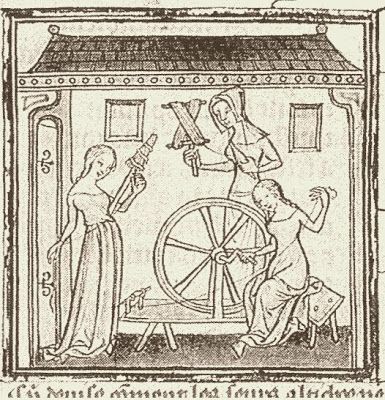
Women spinning, 1500s, Pinterest

We are entering again the female space of winter. Here we find Catterntide, a celebration for lacemakers, on November 25th as we begin our journey, the Anglo-Saxon 'Mõdraniht', or 'Mothers' Night', on Christmas Eve, Mary birthing the Christ child, the Mari Lwyd; the 'Grey Mare' of South Wales, at Midwinter, Women's, or Little, Christmas on 6th January, and Distaff Day & the work of spinning on 7th January as we emerge (we might also trace 'male space', from Martinmas to Plough Monday, but more of that soon).

St. Distaff Day was also a time to honor 'mother’s spit'. Mother’s spit was an important ingredient in flax production, wetting flax fibres with saliva, which contains an enzyme that decomposes the cellulose of the flax into a sticky substance & so helps splice the threads together into yarn.

Records of St Distaff Day begin in the 14th Century, or the Late Middle Ages. It was during the Later Middle Ages that the woollen industry became the major source of income for many, with huge swathes of land dedicated to sheep farming. This was also the time when spinning moved from the domestic sphere; making yarn for use by family and close community, into being a marketable commodity. But these were the years of the Great Famine of 1315 to 1317,
the Black Death, which reached England in 1348, the Hundred Years' War with France; events which killed almost half of England's population and caused economic chaos and the unravelling of the old social order. No wonder that both women and men felt the need to 'draw the line'.

During this time nearly 1,500 villages were deserted and men and women were forced to look for work in towns and cities. Accompanying social unrest brought events such as the Peasants' Revolt of 1381. As an aside, Mr Radical Honey occasionally buys his fine English fellow's apparel in Canterbury from a the great-great-great-etc-etc-grandson of Wat Tyler, and although he works in a very traditional gentlemen's outfitters he definitely has something of the rebel about him!

In the midst of this social upheaval came St Distaff's Day; an acknowledgement that women's work must be done, but also a reminder that we are more than the work we do, more than our usefulness to the economy. There are relationships to be maintained, lines to be drawn between workers and those who benefit financially from that work, lines that everyone is supposed to know about. That the day was dedicated to a saint of course added credence to the determination not to work, or not too hard at least. Saints Days were for feasting, or for its sister fasting, but folk saints' days always fall on the feasting (and drinking) side.

But there is no 'Saint Distaff'. This is yet another example of an 'unofficial saint's holiday' designed to increase the potential for merrymaking. And merrymaking is Resistance. All the same I think that we might confer sainthood on a tool which has so benefitted us for millennia; especially one that holds a chaotic tangle of raw material and allows us to make sense of it; a saint to help us with that work would be welcome indeed.

Observance of St Distaff's Day continued for almost five centuries until the Industrial Revolution took the work of spinning into factories, dividing the women from the men, and moving work from the domestic cottage industries where one could manage one's own time into a sphere and time which was no longer one's own. When work is done by the clock there is no space for a day of merrymaking to get used to the idea of Christmas ending. And we might hazard a guess that the loss of the full Twelve Days of Christmas festivities, symbolised by our traditional 'Twelfth Cake' becoming a cake for Christmas day, meant that women would have returned to work well before St Distaff's Day.

We might celebrate then that Distaff Day is returning as more of us become interested in our old festivals and celebrations; some without quite knowing why, some to honour where we've come from, some as an act of conscious Resistance to the strangle hold of secular time and space.

St Distaff's Day flyer 

St Distaff's Day is the perfect time to gather with others for a post-Christmastide creative afternoon but also, in this time when we are so divided from those who provide us with our material comforts, to consider the lives of the people who make our clothes, often under exploitative and unsafe conditions and with low wages in countries where rules protecting workers are non-existent. We might reflect upon who is doing the 'spinning' now, and are WE the ones who the Resistance must be against? I pray to St Distaff to help us all make better choices in the year ahead.


And here, it comes to me, is the perfect tune to accompany us on these 'wild saint days of Resistance'!


Go on and speak your mind, 
lets find out what it is you have to say 
I hope nobody turns away 
You said it loud and clear; 
We have to work, 
we have to earn our way 
well I'm sorry not today 
Oh I'm sorry not today 

 Truth is if I dont make it, 
then you cant take it 
and if I dont sew it 
then you cant wear it 
truth is if I dont grow it, 
then you can eat it 
And if I dont aim it, 
then you cant shoot it 
It's that little bit left over at the end...

(The Levellers)

We will reclaim this world; not through force but by making holy; one thread, one stitch, one seed, at a time.

References:

St Distaff's Day ~

https://www.ingebretsens.com/blog/on-the-close-of-st-distaff-day/

https://www.tudorsociety.com/happy-st-distaffs-day/

http://www.thebookofdays.com/months/jan/7.htm

http://www.tellinghistory.co.uk/resources/distaff.htm

https://norfolktalesmyths.com/2019/01/02/who-believes-in-st-distaff/

Spinning ~

https://en.m.wikipedia.org/wiki/Spinning_(textiles)

http://spinning-wheel.org/about1/

On 15th Century spinning techniques ~

https://15thcenturyspinning.wordpress.com/2012/06/16/how-did-women-spin-in-the-15th-century/

http://medievaleuropeilluminated.blogspot.com/2017/10/spinning-through-time-distaff-and.html?m=1

The Distaff ~

https://en.m.wikipedia.org/wiki/Distaff

https://www.merriam-webster.com/words-at-play/distaff-meaning

The Spindle ~

https://en.m.wikipedia.org/wiki/Spindle_(textiles)

The Middle Ages ~

https://en.m.wikipedia.org/wiki/Late_Middle_Ages

https://en.m.wikipedia.org/wiki/England_in_the_Middle_Ages

https://en.m.wikipedia.org/wiki/England_in_the_Late_Middle_Ages

The Industrial Revolution ~

https://en.m.wikipedia.org/wiki/Industrial_Revolution

https://en.m.wikipedia.org/wiki/Textile_manufacture_during_the_British_Industrial_Revolution

Women's Christmas ~

https://en.m.wikipedia.org/wiki/Little_Christmas

https://www.irishcentral.com/roots/womens-christmas-nollaig-na-mban-celebrate-ireland


Saturday, 4 January 2020

Now We Live by Starlight ~ the Eighth Day of Christmas


Star of Bethlehem flowering at the 1,000 year church, April 2017

As we come closer to Epiphanytide, which begins on the evening of January 5th; the Twelfth Day of Christmas, we begin to live by starlight. If we take our Christmas decorations down then our homes can feel stripped bare and empty, cold as we sometimes imagine stars to be. But we also become open to the sky. There is nothing between us and forever, and eternity is at our fingertips.

To sink ever more deeply with our starlit journey we might watch this beautiful timelapse film by Harley Grady.


Stars have become more and more important to my own spiritual path and I hope to share something of that over Epiphanytide if I can find the words. But, for now, I want to share something of the star that is most important in the coming days; the Star of Bethlehem. 

Epiphany remembers the visit of the Wise Men, or Kings, to the Christ child, having followed the Star of Bethlehem to find him. There is a belief that our Christmas decorations, especially those representing stars or light, shouldn't be taken down before Epiphany Eve as it might prevent the Wise Men from finding their way. I love that, in folk belief, there is only now; the Wise Men are always travelling, and each Epiphany they arrive, with a little help from the twinkling star trail we put out for them. This is no small thing; we are not irrelevant, no matter how small we feel. Our smallest action is the pivot around which the universe spins. And when our fairylights have been put away and the stars have shifted, there is a little white flower who comes to remind us that that remains true, no matter what.

It's said that the Star of Bethlehem first appeared on the night of Christ's birth to guide the Wise Men, whose journey was made complicated by their maps and charts, to the child. When its work ended it burst into thousands of brilliant fragments and fell to earth. Where it came to ground a blanket of milk-white flowers grew.

You will know that you have found Star of Bethlehem when you see a flower with six white petals surrounding six stamens, each with a yellow anther. They bloom in the spring from early March until late May or early June. The flowers open in the early morning and are usually closed by noon revealing a beautiful green stripe on their underside, hence some of their common names; sleepydick, nap-at-noon, star-at-noon, johnny-go-to-bed-at-noon, and eleven o'clock ladies. When the flowers have died a three-celled seed capsule forms containing several black seeds.

Star of Bethlehem, Wiki Commons

Her genus name, 'ornithogalum', comes from the Greek words 'ornis' for 'bird' and 'gala', meaning 'milk', and was named and described by Dioscorides (40 to 90CE) in his 'De Materia Medica' due to her abundance of white flowers that 'when opened look a lot like milk'. 

In herbal healing she is known as the 'comforter' and is a gentle companion in sitting with the after-effects of shock, even those received long ago in childhood. She has been described as the 'Guardian of Grieving', and used in the treatment of those who are suffering from suicidal depression and Post Traumatic Stress Disorder, offering a light to lead the afflicted out of the darkness. Indeed, she does that work for us all, blooming at the beginning of spring and reminding us of the need to come into the light after the dark winter months. She is the way-shower, a guide for the lost, just as she guided the Wise Men through the vast silence of the desert. Generous indeed for a star who has herself has been broken into pieces; the archetypal 'wounded healer', just as Christ is. I would never trust a spiritual path that didn't know how to honour the parts in all of us that are broken.

I find the image of the star fallen to Earth deeply moving and have often thought of her as a teacher, showing us that it's possible to follow diverse spiritual paths, whilst still being part of one wild and beautiful truth. In her myriad mirrored fragments, her many white petals, her brilliance of being, the Star of Bethlehem reflects them all. There is no 'other', just broken parts of one great beating heart. Perhaps that's why she is sometimes called the 'Reconciliation Star', the star of at-one-ment. And it does feel that there is much to reconcile, and to atone for. There is mending to be done, but we have our guide and she is pulsating with the energy that drives the universe towards justice.

Star Circle, Wiki Commons

But it doesn't feel that there is too much justice in the world just now; not when the President of the United States, who we might remind ourselves is also made of stars, appears to be wilfully driving us towards WWWIII, a war which many of our sisters and brothers would be justified in saying started many years ago. The world truly does feel shattered into a thousand sharp and ragged pieces.

Three years ago, in the wake of several star-shattering world events, a poem came whilst I was writing about the healing properties and folklore of this little white flower. Much of this piece of writing is based on that. If you would like to read it you can find it here. I continue to pray, as I did then, that by the time she returns in the spring there will be much healing between us to be held out in offering to her. Epiphanytide is our opportunity to realign ourselves with the star who, like Christ, fell to Earth to help us mend.

Star of Bethlehem is tired 
of dragging around the baggage 
that we try to hide, 
divisions that won't be reconciled, 
the willful non-seeing of the so-called wise.

Wakes bright with morning, 
asleep by noon, 
offers guidance with maps and tea; 
pours milk, leaves not bags, 
her best bone china 
slips from her exhausted hands, 
smashes into a thousand shards of stars 
on her kitchen floor, 
reads the auguries in their constellations.
Weeps for the weight of what she sees 
swept under the carpet. 

Star of Bethlehem carries diversity 
as a prayer in her shopping bag, 
walks with Jah, Allah, Shekinah 
wearing goose feathers in her hair 
in the stews of the Liberty.

Keeps a torch by the back door, 
shines a light on intruders ~ 
Guantanamo, Yemen, Syria, 
the housing of the poor, 
a nail bomb on Electric Avenue, 
knows that she can't take much more. 
No amount of bleach in her bucket 
will make this pure.
No amount of soap will scrub this whole.
And her batteries are running out. 
She may have to brave the dark. 

Star of Bethlehem hangs her head
in the churchyard 
closes in on herself at shadow fall, 
offers her flesh for the breaking of bread,
ties her scarf more tightly round her head.

Tuber or tumour, hate or hope. 
The murder of the innocents, 
child radicalised, 
drowned on the refugee boat, 
finding belonging in the EDL, 
bleeding out in the stairwell in Peckham Rye.
Herod turns his head, shuts his eyes, 
she opens her petals wide. 

And she is growing wild, 
escaping the confines of the flower bed.
Sinking her roots into holy ground, 
gathering up the pieces that she let slip, 
knows it's time to get a grip. 

She weeps for mercy, grieves for grace, 
what we might have been, what we are. 
Yet still she loves the pilgrim soul in us, 
the spark that journeyed 
from the furthest star 
and fell to earth forged in fire. 
She puts the kettle on. 

~ Jacqueline Durban, 2017


Star of Bethlehem flowering at the 1,000 year church, 2017

References:


Saturday, 21 December 2019

Approaching Solstice ~ Celtic Advent Day 25

Approaching Solstice, Seabrook, Kent, 19th December 2019

'Then God said, "Let there be lights in the expanse of the heavens to separate the day from the night, and let them be for signs and for seasons and for days and years."'

Genesis 1: 14

I have found myself in a wordless place over recent days and so unable to share the many half-formed thoughts that have settled into my bones and moved under my skin in the Midwinter dark. I have though been grateful for this deeply dreaming womb space in order to allow the unformed to take form, or that is what I hope.

As I write I am awaiting the moment of Winter Solstice; in the British Isles this will be at 4.19am on Sunday, 22nd December. As the day unfolds there will be a Sunday service, the fourth of Advent, and a carol service in the afternoon. I am muchly looking forward to both, but the Winter Solstice carries an older tide that must be acknowledged before the fourth candle is lit; a welcome light, kissed awake by the Midwinter sun to celebrate our successful journey through another longest night.

It has been mentioned to me several times of late that it is perhaps wrong to mix spiritual work with politics, especially in the wake of the recent UK election. Whilst I acknowledge that this is not the path for everyone and it is important not to create further division as best we can, I vehemently disagree with this position. For me the work is to mend the broken threads between the sacred and the profane until all life is re-enchanted. And politics, which takes many forms, is often the place where heart and hope come to catch a spark. Why would we want to hold Spirit separate from that? It seems to me that its wisdom is badly needed there. When I have walked with so many others in the Grenfell silent walk, or stood on a cold and rainy roundabout in Dover at the Refugees Welcome vigil, the Christ that I know is with me.

It is the same for the older, wilder festivals of our pre-Christian ancestors; our barrow makers, our henge builders. It is also often suggested that to follow these older festivals, so deeply attuned to the rhythms of the Earth, is 'superstition' and to be avoided. Again, separation is used as a tool to disempower us; politics with Spirit at its heart is less easily taken over by greed and hunger for power. Spirit with the land and the stars at its heart is less easily co-opted for the benefit of secular, dare I say, Imperial ideology. Christmas tells us that 'God so loved the world...'. Why then would we not acknowledge and celebrate evety aspect of it? We need to root back in until every bush is burning.

The journey of the Winter Solstice sun. Image: NASA
     
And so we come to Winter Solstice, the acknowledgement of which Sarah Sunshine Manning, citizen of the Shoshone-Paiute and Chippewa-Cree tribes, describes as a 'decolonial act'. And so it is. In this post-Industrial world, where our only worth comes from how much we produce, we are not meant to slow down, or grieve, or gather together to tell stories, or sit to share food, or rest. It just all takes too much time, time which could be more productively spent in other ways. Time itself has been colonised now and we need to take it back. We need to remember when we were able to sink into the season, into the moment, without a thought for the next. And Winter Solstice, and the longest, darkest night, are the perfect time for that. Which is why I value so deeply that, as I write this, I am listening to a single bird singing for the rebirth of the Solstice sun. It is a perfect moment; my own creativity held in a chorus of grace notes.

'S/he made the moon for the seasons. The sun knows the place of its setting.'

Psalm 104: 19

I want to end by sharing my favourite Midwinter Solstice poem; 'Approaching Solstice' by Patricia Monaghan, which never fails to make me cry.

Snow on Blackheath, 2011

Approaching Solstice, Patricia Monaghan

Yes, friends, the darkness wins, but those
short days so celebrate light:

Today the lemon sunrise lasted a few 
hours until sunset, all day the snow
glowed pink and purple in the trees.
This is not a time of black and white.

My friends, outside us. Among us, too,
let's sing what winter forces us to know;
Joy and colour bloom despite the night.
We measure warmth by love, not by degrees.

Snow on the Somerset Levels, December 2010

I wish a blessed Winter Solstice to us all.


References:

https://ndncollective.org/acknowledging-the-winter-solstice-is-a-decolonial-act-for-indigenous-people/

https://www.myjewishlearning.com/article/hanukkah-and-the-winter-solstice/

Monday, 16 December 2019

Defiance in the Dark ~ Gaudete Sunday for Celtic Advent Day 23


The third candle has been lit on our Advent Crown and the light is quietly increasing, although it may feel to many of us that the darkness has deepened since last I wrote.

The UK general election results have left many reeling and deep in grief, and I am amongst them. I have tried to write, and have several half finished pieces to share, but often I am rendered wordless by events or am trying to manage in my own ineffectual way the distress ebbing and flowing here in the hedgehermitage since the vote took place. My husband, who has Asperger's and has already had most of his support from our Government removed and who is currently in the midst of yet another assessment process, is overloaded and overwhelmed. I feel for those, and there are many, who are much less well off than we are.

And so, I breathe deeply as I write that this week's candle, the third of Advent, was dedicated to Gaudete Sunday and to joy.

Gaudete Sunday takes its name from the Latin word 'gaudete', 'Rejoice'.  Some of us may be familiar with the word from the song of the same name by Steeleye Span.


Ever so lovely.

Gaudete in Domino semper: 
iterum dico, gaudete. 
Modestia vestra nota sit 
omnibus hominibus: 
Dominus enim prope est. 
Nihil solliciti sitis: 
sed in omni oratione et 
obsecratione cum gratiarum 
actione petitiones vestræ 
innotescant apud Deum. 
Benedixisti Domine terram tuam: 
avertisti captivitatem Jacob.

Rejoice in the Lord always; 
again I say, rejoice.
Let your forbearance be known to all,
for the Lord is near at hand;
have no anxiety about anything,
but in all things,
by prayer and supplication,
with thanksgiving,
let your requests be known to God.
Lord, you have blessed your land;
you have turned away the captivity of Jacob.

Philippians 4:4–6; Psalm 85 (84):1

This reminds me of Mary's fierce and revolutionary song, the 'Magnificat', which was the first thing I thought to write about as the Election results came in; 'He has filled the hungry with good things, and the rich he has sent away empty.' These songs are not an inventory of what IS but a call to what will BE. Here, is Paul's own song in the face of suffering, written to the Philippians as he awaited sentencing and certain execution at the hands of the Roman Empire; 'Rejoice in the Lord, always'. Not their Lord, of power over and might; OURS, the Peasant King of the World Turned Upside Down. Or, as our priest Eileen described it yesterday, "the upside down world of justice and joy." To find joy, to be joyful in the midst of despair, this too is the Resistance. And that is what Advent is all about.

Theologian Henri Nouwen described the difference between joy and happiness by explaining that happiness relies on external conditions but that joy is knowing that we are held in absolute love and that nothing can take that away. I'm not sure that many of us feel secure in being held in absolute love, despite it being true, but I do agree with Henri Nouwen that joy can be present in the saddest of times. This is what Small Beauties, which I have written about many times before, teach us; that circumstances may sit on us like a dark and increasingly stormy cloud but, every now and again, the sun will come out and we will glimpse wonders.

Last Saturday, still feeling tearful, heartbroken, and raw, I ventured out as I had promised to deliver some leaflets about lovely Christmas happenings. I didn't want to go but I made myself because I had promised. This is anothet reason why community and respobsibility matter; they force us out when we might otherwise curl in ourselves and perhaps never fully reemerge. And so I went out and I did experience moments of joy.

I found that the Goat Willow down the roadhas new leaf buds, I found a newly-revealed-by-winter bird's nest, the bare-branch trees were beautiful against the winter sky, Solid Dennis, our cat companion, found a new sitting place, I played pee-bo in church with a toddler who was fascinated by my bindi and flower hat, I found a quince bush, I received a surprise gift in the post, our new giant bag of bird seed arrived, and our garden was visited by the Mac Gwylan herring gulls who nest on our roof and a stunning magpie.

Some of this weekend's small beauties & moments of joy

And all these things delighted me, even the trees despite them being the only few survivors of a new housing development.  Or perhaps, because of. In this complicated and complex world we often discount what's beautiful, what brings us joy and hope. We so quickly move to, "yes, but....". We don't need escapism or false positivity but we do need moments of joy. They are respite and food for the long journey to justice. To me these little joys are fleeting but perfect moments of connection to the spark of Creation when everything else falls away. We need those.

And respite is just what Gaudete Sunday is all about. As I have written before, following an older tide, Advent once echoed the fasting and austerity of Lent and, like Lent, lasted for forty days, beginning at Martinmas on 11th November. This was known as 'St Martin's Lent', a name by which it was known from at least the 5th Century.

In the 9th Century, Advent was reduced to the more familiar four weeks (or four Sundays) but remained a time of repentance and fasting. Gaudete Sunday, like Laetare Sunday in Lent, falls halfway through this time and is an opportunity to celebrate the closeness of Christmas Day without the accompanying austere practices. There is only so much that people are willing to take! I also recall that there are several made up saints' days during Advent as further excuses for frivolity.

I have long maintained that spring, not winter, is the season for self-denial and gentle fasting and the efforts of our ancestors to find reason for a knees up during Advent is further proof of that.

And so, Gaudete Sunday has opened us into a week of joy in the midst of deep despair for many. This is perfect Advent work; not to suggest that life is easy, but to accept the challenge of finding sweetness in the sour, to affirm that the 'upside down world of justice and joy' is a reality whose time will come, despite the evidence of injustice and sadness all around us, and to be defiant against the dark.

Christingle at St Martin's 1,000 year church


References:

Gaudete Sunday https://en.m.wikipedia.org/wiki/Gaudete_Sunday

Laetare Sunday https://en.m.wikipedia.org/wiki/Laetare_Sunday

Phillipians https://en.m.wikipedia.org/wiki/Epistle_to_the_Philippians

Saturday, 7 December 2019

Molecules of Mercy ~ Celtic Advent Day 18

Hogfather stamp

We are coming to the end of the first week of traditional Advent (with the older and wilder Celtic Advent beneath it). This week I have been writing about hope, something which feels in short supply at times. And I have mentioned my feeling that it doesn't really matter if a belief has objective reality as long as it gives us hope, or peace, or joy, and harms no one. It matters so much that we have strength for the journey. Which is why I have never quite stopped believing in Father Christmas, or believing that us believing in him makes him real at least. Because I believe in us.

There is a quote from 'Hogfather' by Terry Pratchett, who I often go to for words of wisdom. It always takes me aback with its raw and honest beauty, only faintly hidden beneath Terry Pratchett's warm and wondrous humour. This quote often makes me cry, because even on my most despairing and cynical days it touches the little spark of hope in me that never goes out, the belief that if we wish for something hard enough it will come true.

In 'Hogfather' Death tries to take the place of the eponymous Hogfather, a mythical being who seems to be a cross between Father Christmas and a Norse God. On Hogswatch Night (December 32nd), the Hogfather grants children wishes and brings them presents, and he is also responsible for the sun rising. But he has gone missing, kidnapped by a group who want to stop children believing in him, or in anything, and there are plenty of people in our own world who would love to do that. Belief is a fragile thing, and Death knows that it matters just as much as the sun rising. Both would mean the light going out. Here, Death explains to his grand-daughter, Susan, why belief matters so very, very much...

"All right," said Susan, "I'm not stupid. You're saying that humans need...fantasies to make life bearable."

REALLY? AS IF IT WERE SOME KIND OF PINK PILL? NO. HUMANS NEED FANTASY TO BE HUMAN. TO BE THE PLACE WHERE THE FALLING ANGEL MEETS THE RISING APE.

"Tooth fairies? Hogfathers? Little ---"

YES. AS PRACTICE. YOU HAVE TO START OUT LEARNING TO BELIEVE THE LITTLE LIES.

"So we can believe the big ones?"

YES. JUSTICE. MERCY. DUTY. THAT SORT OF THING.

"They're not the same thing at all!"

YOU THINK SO? THEN TAKE THE UNIVERSE AND GRIND IT DOWN TO THE FINEST POWDER AND SIEVE IT THROUGH THE FINEST SIEVE AND THEN SHOW ME ONE ATOM OF JUSTICE, ONE MOLECULE OF MERCY.  AND YET -Death waved a hand. AND YET YOU ACT AS IF THERE IS SOME IDEAL ORDER IN THE WORLD, AS IF THERE IS SOME...SOME RIGHTNESS IN THE UNIVERSE BY WHICH IT MAY BE JUDGED.

"Yes, but people have got to believe that, or what's the point---?"

MY POINT EXACTLY."

(From Terry Pratchett's 'Hogfather')

And this is why it doesn't matter to me whether our belief has an objective reality.  It only matters that we believe in something. Something that tells us that life is worth living and that we can be better than we often reveal ourselves to be. As, the ever wise, Death also tells us, MERE ACCUMULATION OF OBSERVATIONAL EVIDENCE IS NOT PROOF.

A few days ago I mentioned the belief of writer David Southwell, curator & recollector of Hookland that 're-enchantment is Resistance.' I am quite sure that Tery Pratchett would agree.


'Happy Hogswatch' by funkydpression


References:

Hogfather ~

Buy the book from Waterstones

Buy the DVD (I am not familiar with this seller but wanted to find an alternative to Amazon)

Quotes ~

https://www.goodreads.com/work/quotes/583655-hogfather

http://www.chrisjoneswriting.com/hogfather.html

On Hogfather as the best defence of Christmas

https://io9.gizmodo.com/terry-pratchetts-hogfather-is-best-defense-of-christmas-1747414176

Friday, 6 December 2019

Singing for Hope on a Rainy Roundabout ~ Celtic Advent Day 16

Kent Christian Peace Activist Refugees Welcome signs

I am several days adrift with my sharings for Celtic Advent and so I hope that I will be forgiven for posting several morsels today. There is so much loveliness that I want to share.

Firstly, I want to tell you a little about the Kent Christian Peace Activist 'Refugees Welcome' vigils, which take place from 7.30 to 8.30am on the first Friday of every month in Dover on the roundabout opposite the ferry terminal, which is where we found ourselves this morning.


I have been attending the monthly vigil since October 2018 and it has added so much richness, and reality, to my spiritual life. I won't say that it's always easy. Often there are only two of us and we could so easily fall into believing that our efforts are futile. But even that provokes many conversations on hope and how to sing and pray for better in the face of, what seem to be, overwhelming odds against anything ever changing. As I wrote only a few days ago, we can't say that we truly have hope until we have stood on the bitter edge of despair, and in reality in this country very, very few of us have done that in the same way that refugees are compelled to do.

And so we talk about hope; about being imaginal cells, about the promise that God will change everything in an instant ~ how then can we truly despair ~ and today we talked about the feeling that "everything is going backwards"; that the anti-life cult of Empire and patriarchy is increasing its grip, but which might instead be us sensing the death throes of a dying system desperately trying to cling to power. I have believed the latter for many years, and in that time I have watched many deaths. It has always been my experience that just before death a being shines even brighter, a last burst of flame before the light goes out and transformation comes. I am sure that its the same with outworn and outmoded systems.

The root of this thought came when I went to a talk given by author Lynne Sinclair-Wood in London a decade or so ago. She lived in Australia but over the years had spent much time in the British Isles, and particularly in London. During her talk she expressed despair that it felt that money makers and financial institutions had a stronger grip on the city than they ever had before. But I didn't agree. What I felt was that what had been underground; an alternative way of being based in sharing, compassion, love, and justice, had become stronger, was rising up to meet the oppressive systems of greed that we have all lived under for so long. And that it was this sudden clash that she was feeling. When power-over ways of being fully held sway, felt unthreatened, there was no need to stem a rising tide of justice; then we were a river, now we are the sea. The grip of greed might have tightened but, if so, it was out of fear that the systems that fed it were crumbling. The human world turns slowly. It might take a lifetime for change to come. I may never see it but I know in my bones that it's coming, that the arc of the universe is always towards justice, towards Kin-dom.

Some would say that this is wishful thinking and idealism. I say, so what!? In a despairing world it doesn't matter whether this is objectively 'true'. It only matters that it helps us to have hope. This is the work; the work of Advent. It's what we do while we're waiting.

And so, this morning at 7.30am, we were standing on a cold and rainy roundabout in Dover, as we do every month. The police used to stop; sometimes they were nice, sometimes they weren't, but now they rarely stop at all. Perhaps they think us 'safe' or 'irrelevant', but I am mindful of all those who have been thought the same but who have 'turned the tables over' nonetheless. Often we are shouted at by drivers, and quite agressively so. And often, and increasingly, we are given hoots of support. Invariably the person we now call 'sausage roll man' drives past, eating his sausage roll and waving encouragingly. He has a fine beard. He often gives us hope on our most despairing days. Last month, a man who had waved at us from his car emerged from a hotel just near the roundabout as we packed up our things to leave and told us that we were doing a fine thing, that he worked in the hotel, and that if we ever got too cold and wet we should go in for a hot drink. The universe is moving towards justice, but we might not see that from our tiny human perspective. In which case, what we can do is gather up these sweet and fleeting moments into a brew and a balm to keep us standing up for what we believe to be right.

We often say that we are an 'Easter People'; that we are living a 'Resurrection life', and so we are when we must so often be born again from the ashes of despair, and living as we do on a planet of seasons where spring follows winter, summer follows spring. But we are also an Advent People in a constant state of waiting. Holding the tension between these two sacred truths is where we find the Holy One, arms outspread.

We wait until change comes, and that could be at any moment; every breath it's own small resurrection, or it might take forever. What we do while we wait is what matters.

Today it felt that our time on the roundabout was particularly joyous. Perhaps because we are waiting, expectantly and at times impatiently, for better, but we are also close to a point when we can put our waiting aside for just a little while ~ the Peasant King will soon be born and he will Turn the World Upside Down, just as he always has. If the anti-life cult of Empire ever thought that it was safe then it has always been wrong. Here, soon, is a vulnerable child who will break their frozen places into Light.

White Cliffs of Dover

And so, we sang in the cold and the rain; 'Blowing in the Wind' ~ how many times can a man turn his head & pretend that he just doesn't see? ~ 'Jerusalem' ~ I will not cease from mental fight ~ 'O Holy Night' ~ a thrill of hope, the weary world rejoices, fall on your knees, O hear the angel voices ~ and 'O Come, O Come, Emmanuel' ~ O come, bright Daystar, come and cheer, our spirits by your advent here...

Singing, like poetry, breaks the world open, and so we did. There is hope in any voice that rises above the wind and the rain. This is the work we do while we wait; we keep our voices strong enough to rise above the storm. Whatever our faith, we find our ways to kindle hope.


Thursday, 3 October 2019

On Operation Christmas Child; Colonialism Masquerading as Charity


Earlier today I met a stunning Ichneumon wasp & deep-hearted & wise Birch Moon Wisdom on Instagram commented that wasp medicine is afoot. I agree! On so many levels, now that I have almost recovered from how beautiful she was, my meeting with her was significant, but perhaps more of that soon. In the meantime, I am reminded that several times in my life I have been accused of being 'waspish', that insult which is so often cast at women who speak their minds. And this week I have had to speak my mind in a way which I'm sure was unwelcome, & that's where I come to the angel because this was about Christmas.

In the 1,000 year church last Sunday we were given a talk on Operation Christmas Child, whose parent organisation is Samaritan's Purse, a US Evangelical Christian group which provides disaster relief throughout the world.

Operation Christmas Child organises thousands upon thousands of shoeboxes to be filled with Christmas gifts by well meaning people, including in our schools and churches, & then distributed to children who have been affected by war, famine, poverty, disease, & natural disasters. Since 1990, more than 168 million children in over 160 countries have been given shoeboxes; an astounding feat. It sounds so lovely, so kind, & in this complex & bewildering world we so need things that are kind. But truly Operation Christmas Child isn't kind or lovely at all. 

Firstly, Operation Christmas Child is evangelical, hoping to convert children & their families to Christianity; the sort of Christianity that voted Donald Trump into the White House & believes him to be doing 'God's work'. Ironic then that this organisation which professes to care for children supports a man who has overseen the removal of migrant children from their families, the deportation of parents whilst their children were at school through ICE, & the incarceration of children at the border with Mexico. Whether evangelism itself is a good thing might be debated (I say not) but evangelism of this nature; fundamentalist & done by offering shiny gifts to vulnerable children who are first obliged to attend a 'prayer meeting' is beyond both religious & human decency. And it could so easily be argued that the inequality of power in that exchange makes it almost impossible for any conversion to be freely arrived at. As one commentator said, "You have desperate people and you have someone who has food in one hand and a Bible in the other."

In addition, the president of Samaritan's Purse is US evangelist, Franklin Graham who has been accused many times of hate speech & who was quoted in last Sunday's talk. Indeed it was that that made me investigate the organisation more deeply. 

Franklin Graham has spoken out against LGBT rights & in favour of conversion therapy, he supported the Iraq war & most definitely supports Donald Trump. Furthermore, he considers Islam to be "evil and wicked" & has said that Muslims should not be allowed to enter the US. It is ironic that his own organisation is named after the parable of the Good Samaritan, a story about overcoming bigotry towards those we consider 'other'. That is certainly not something that Franklin Graham is able to do. And, in addition, he is the highest paid CEO in the charity sector in the US. It must be hard indeed to consider the opinions of others when you can't hear them over the rattling of your own money.

In short, Operation Christmas Child benefits financially & otherwise from the continuation of war & injustice; a worldly system of greed openly supported by their president. You cannot provide 'relief' to the victims of war with one hand whilst cheerleading for it with the other. 

And this is certainly not the teaching of Jesus, a radical preacher in an occupied land who spoke out against injustice in all its forms. We must remember that he was murdered by the forces of Imperialism, and Operation Christmas Child is Imperialism in action; self-soothing by offering shallow charity, whilst ignoring, feeding, & even benefitting from, the deeper roots of injustice. Chillingly, Revd. Giles Fraser points out that US evangelism "systematically confuses the kingdom of God with the US's burgeoning empire. It is no coincidence that the mission fields most favoured by US evangelicals are also the targets of neo-conservative military ambition." And, of course, the more children and adults in distress, the more money Franklin Graham & Samaritan's Purse makes, and the more opportunities they have to create compliant & reliant Christians. This is the most terrible face of Christianity, and of any religion. 

Indeed, this is not truly Christianity at all. To follow Christ is to be counter-cultural, to demand the 'world turned upside down', to 'do justly, love mercy, and walk humbly' (Micah 6:8), or to do our best to at least. Operation Christmas Child/Samaritan's Purse is none of these. It is thinly disguised Colonialism by another name, and it preys on well meaning people, including my kind friend at church, who wish to share their prosperity with those who are less fortunate to spread its poison.

I am pleased to say that several organisations in the UK no longer support Operation Christmas Child by allowing their premises to be used as collection points. These include, Oxfam, the South Wales Fire Service, DHL, the Inland Revenue, & the Co-op. Surely our churches and our schools must do the same.

If we are to survive these times we must be better than this. We have to have difficult conversations, look and think more deeply, speak out; even if that means being considered 'waspish', be willing to listen and to change, sometimes to give up what we had held as good and precious and kind. And we have to transcend the attitude that tells us that a few plastic gifts in a shoebox makes up for hundreds upon hundreds of years of systematic exploitation and oppression. Then we might truly be doing God's work.

But, until we do, Christ have mercy.

There are several fine, Christian and otherwise, alternatives to Operation Christmas Child shoeboxes. Here are a few that I've been told about. Please let me know if you know of others.

https://linktohope.co.uk/shoebox-appeal-2019 ~ provides shoeboxes to families & the elderly to those in need in Eastern Europe

https://www.msrm.org.uk/liab.html ~ a Mustard Seed Initiative supporting children in Eastern Europe 

https://www.marysmeals.org.uk/get-involved/campaigns/the-backpack-project ~ a year round initiative to fill a backpack with everything children in Malawi need for school; clothes, art materials etc

References:

http://emilyjoypoetry.com/7-reasons-not-to-participate-in-operation-christmas-child-this-year   https://en.wikipedia.org/wiki/Samaritan%27s_Purse#Controversy   http://humanistlife.org.uk/2015/10/14/why-parents-shouldnt-support-operation-christmas-child/   https://www.cornwalllive.com/news/news-opinion/truth-behind-your-childs-operation-854545   https://baptistnews.com/article/10-alternatives-operation-christmas-child/   https://baptistnews.com/article/stuffing-shoe-boxes-for-the-worlds-poor-maybe-you-should-reconsider/#.WbXydbJ96M8   https://humanism.org.uk/humanism/humanism-today/humanists-doing/good-causes-and-charities/samaritans-purse/   https://www.theguardian.com/society/2003/jan/15/fundraising.guardiansocietysupplement   https://sites.google.com/site/occalert/   https://www.theguardian.com/world/2003/nov/10/religion.society   https://www.newstatesman.com/religion/2013/10/operation-christmas-childs-shoebox-campaign-just-propaganda-tool-christianity   http://www.inminds.com/occ.html   https://www.liverpoolecho.co.uk/news/news-opinion/wont-donating-christmas-charity-shoebox-13796645   https://www.secularism.org.uk/charities/operation-christmas-child.html   https://www.secularism.org.uk/opinion/2014/11/  

Thursday, 4 April 2019

On Gift Giving and the Wild Eye of Prayer

A small gift from the Mac Gwylans? Plus a tiny slug.

Today I have had a chat to the everyday angel pigeons in our garden, together with indulging in a rather acrimonious exchange with a jackdaw, who seemed to feel that I wasn't putting his breakfast out in quite the right way. I was faffing about a bit I know but Jackdaws can be terribly demanding.


An everyday angel, beautiful in the blossom 


Speaking of demanding, I thought that I would share with you this possible tiny wonder and small beauty. Every Wednesday I pop to the shops and for a coffee with my dad-in-law. Yesterday we set off as usual and our garden path was empty. When we came back several hours later the ceramic decoration from one of the pots in our back garden had appeared exactly in the middle of the path! It is quite large; maybe 3 inches across, and is biscuit-thin so it must have been carried and put down very carefully. It is a mystery.


Beautifully placed in the centre of the garden path

My only thought is that Mr Mac Gwylan  the herring gull ('gwylan' is Welsh for gull) gathered it up and put it there. Things tend to move around here, as both the foxes and the magpies like to pick things up, play with them, and then put them down somewhere else. A magpie recently appeared with the cover of one of our long-gone garden lights, which is like a little sparkly ball, in his beak and it is now often put in, or taken out of, our garden pots. I have also seen a magpie do the same with a piece of broken pot, but I think that this is too large for a magpie to carry so carefully and the foxes would have been fast asleep at that time of day.


Mr Mac Gwylan considering my shortcomings as a host 

You may recall that last year we looked after a herring gull chick who had come down from the roof too early in the exceptionally hot weather and had hurt his wing. If you would like to read more about him you can do that here. He was here for a few days and his parents were watching closely. There was much communication between adults and chick, although they didn't venture down into the garden. Eventually he had to go to a specialist wildlife rescue centre as we were afraid that his wing was broken (It was only a sprain. Phew!) My husband, Simon, spent much time explaining to the chick's parents that he was safe and that we were doing our best for him. We were sad at the thought that they might consider him lost.


Steve Mac Gwylan, the baby herring gull

Every year, gulls return to the same place to nest and we were overjoyed when the Mac Gwylans returned after New Year. In the past we haven't had much to do with them, other than admiring them on the roof and ooohing and ahhhing at their gangly babies, but this year they have been popping down to the garden to drink from the pool of water Simon made for last year's chick to splash in and I have been putting out a few mealworms for them by the garden gate. Generally, Mr Mac Gwylan comes down first and his lady sits on the roof making concerned noises, but she comes down too in the end or he goes up to get her. Yesterday, when I went to fill the bird feeder, which they can't get to as their wings are too wide, he made it quite clear that they would also like some snacks. I wonder whether the ceramic disk was a thank you, or a bribe! Either way it was lovely to wonder about that and I have put it on our garden table with all our other nature finds.

The more that I spend time with the birds the more I feel that I understand (a little) the amazing complexity of their communication, the richness of their social interactions with one another, the tides of their cyclical comings & goings. It is a beautiful thing. And a privilege to even consider that they sometimes notice me. They feel like family and they make this feel like home.


Everyday angels

Today, I had hoped to write about St Cuthbert, which I have been planning to do for several weeks, but what follows is what came instead. As Cuddy is sometimes credited as the ‘first conservationist’ for introducing laws to protect nesting seabirds on the Farne Islands as long ago as the 7th Century, and was said to have been brought gifts by ravens, perhaps I have written what he would have wanted after all. I try very hard to listen to what the day asks of me. I will return to him soon, to Welsh St Cenydd, who was born with a disability and cast out to sea in a willow basket only to be rescued by seagulls, and to Irish St Caoimhín, who had a blackbird build a nest and lay an egg in his open hand when he stretched out his arms out to pray, and who remained in stillness until the egg hatched and the fledgling flew. We have much to learn about relationship with the wild from our holy ancestors.


'St Kevin & the Blackbird, Clive Hicks-Jenkins. From https://blueeyedennis-siempre.blogspot.com/2012/05/st-kevin-of-glendalough.html

Returning to our gift from the gulls; of late there has been a lot of discussion here and there about the language we use when referring to the natural world. How, if we are to play our part in preserving or even saving, words matter and need to speak to the heart. We need to fall back in love with the earth. One thing that particularly struck me was the suggestion to stop talking about 'nature reserves', as though some bits of earth can be set aside for nature to live quite happily whilst we do what we like with the rest ~ to be fair, that is the prevailing mindset but it really needs to be challenged. There is no room for complacency or for feeling pleased with ourselves just because we allow something, anything, to stay green. Instead, we might really engage with what is happening and speak of 'nature refuges'; a place of sanctuary for our wild refugees who have had their homes taken by diggers, and landscapers, and poisons, who have been chased across an increasingly barren land to the very edges of endurance and survival. Our gardens, or even a little balcony or a windowsill, can be refuges too, no matter how small or unpromising we might consider them to be. It is a privilege to be in service to and to watch over any land in a world where so many are landless. There are (a very few) people on this planet who don't care about life, not even their own, and those of us who do care have to hold the line for life itself. All of nature is speaking; “don't mourn, organise”.

We have increased numbers of everyday angel pigeons here now because the army barracks, where so many had roosted, probably for generations, were bulldozed last summer to make room for a new estate. It is the same with the fire-flame foxes. There are more and more squashed into a smaller and smaller area because their earths and hunting grounds have been taken from them. No wonder that mange spreads amongst them. We are currently treating several who visit our garden and who are in a sad state. The badgers are gone; their setts, possibly centuries old, abandoned or lost, or perhaps they just can't bear to come this way. We shouldn’t assume that a badger’s heart can’t also be broken. Rats, who had lived quite happily in the, by now empty, army barracks were forced into the nearby estate and were poisoned. To discourage them trees and bushes were cut down. Before that, despite their close proximity to human habitation, they had bothered no one. The one strip of green that isn't mowed every spring by the council has also been poisoned, dowsed in glysophates, parched earth. Others put down astroturf, because we are all just too busy to care for our gardens. And I don't judge, or try not to; we’re ALL pushed to the very edges of endurance and survival in one way or another and it is just one more thing amongst many. We all fail. There is just no time to care in a world where caring only breaks our hearts, but that is not an excuse, not really. The crows' nests; 100 year old trees, have been felled; there was a man, a tree surgeon, almost in tears over them at a developers 'consultation' event here last year. And even the 'affordable housing' for these new estates are squeezed out to the edges too. It is all the same thing; what we do to the wild we do to ourselves. They cut down the crows' trees, destroy the foxes' earths, and make neat little boxes as battery farms to keep us, the fodder of Capitalism, just happy enough, but worn down just enough too.


Nina George in her Spring 2016 essay, ‘Everything Breathes the Revolutionary Spirit’, for ‘Gods and Radicals’ quarterly which I return to for sustenance again and again, tells the story of four men who were hanged in Chicago in 1887 for being leaders of a movement demanding workers’ rights and an eight hour day. All of the men spoke passionately and eloquently in court in their defence. One, August Spies, used examples from nature to suggest that revolution and resistance are a natural state; that “a force can be brought to try to push us down but this can never stop us. We rise. We grow. No one can stop the inevitable growth of the land, its people, and the forces we contain...Revolution is ever present in all beings’ spirits and lungs.” Everything breathes the revolutionary spirit; a plant that’s cut down will grow again wherever it can, birds who lose their brood will lay more eggs. Life is always bubbling up through the cracks. We must embrace that energy; finding the cracks where life can get in and playing our part in putting it, and keeping it, there for as long as we can. And if, and when, that fails, we must look for more cracks. As Nina George writes, we must be “the green fuse that refuses.”

And we do all need to refuse and find refuge; not to be thought of as us doing our wildlife a 'favour', because we need refuge too and I am quite sure that I gain more from the beings who find shelter here than they from me. But this is one time when we are all in it together. All of nature is in deep communication and trying to communicate with us, in solidarity. “Wake up!” they say, “remember that you are not alone.” The badgers, the foxes, the nettles, the blackthorn, the bees; everything breathes the revolutionary spirit. And of course they are speaking to us. Our planet is dying and we are the ones who are killing her. Why would they want us to give up and sink into despair? There is only even more death that way.

But we do have power, although we are encouraged to think otherwise. Where there is still even the tiniest piece of land for us to call kindness and generosity in there is hope. And so I will rejoice in being told off by jackdaws, and in spending money we haven't got on birdseed, and speak out when it's suggested to me that we buy wheat-free seed to 'put off' the pigeons, because what matters more in life than the breaking of bread in good company, and I will believe that the herring gulls, who are on the RSPB red list as being 'at risk' on our hugely nature depleted little island, have brought us a precious ceramic disk as a gift, because I have to believe that they too know there is still love and hope in the world.

"For Earth to survive, she needs your heart. The songbirds and the salmon need your heart too, no matter how weary, because even a broken heart is still made of love. They need your heart because they are disappearing, slipping into that longest night of extinction, and the resistance is nowhere in sight. We will have to build that resistance from whatever comes to hand: whispers and prayers, history and dreams, from our bravest words and braver actions. It will be hard, there will be a cost, and in too many implacable dawns it will seem impossible. But we will have to do it anyway. So gather your heart and join with every living being.” (Deep Green Resistance)

Thank you, Mr and Mrs Mac Gwylan for the wild eye of your prayer. I am listening, with every cell I am listening.


True love

Aho mitake oyasin. For all our relations.