Showing posts with label Nearby wild. Show all posts

Saturday, 4 April 2020

The Blessings on our Doorsteps & Dying Alone in the Time of Corona


Hello dear readers. I hope that you, and those you love, are well in these extraordinary times. This is just a small sharing before I write more in the weeks to come, especially as we move into the strangest of Holy Weeks & Eastertide. For now, we are continuing our forty days & nights in the wilderness, which has seemed so deeply apt this year. But, of course, it is a wilderness whose blessings we have unlearned how to see.

We are well here in our self-isolation and I have been enjoying many heart-opening walks, during which I have foraged for wild medicine. I have bern hugely drawn to nettles, who I am finding more and more ways to incorporate into my diet, and also to cleavers spring tonic, of which more soon. Today, I have heard that it's going to be beautifully sunny for many of us and so I am hoping to go for a little walk to the woods to see if I can find wild garlic. These are blessed times in so many ways.

But I wanted to write a little about another nearby plant and all that her presence and recent flowering has led me to reflect upon.

The plant pictured above is beautiful herb-Robert, also known as red robin, fox geranium, & stinking Bob, amongst many other names, who has come into flower just by our front door.  She has so many wonderful edible and medicinal qualities that I'm quite determined to write a longer blog about her soon. But what her presence makes me think about today is how supported we are by the other-than-human world, and otherworld, that surrounds us.

Aside from herb-Robert, on one side of our front door we have cleavers and, on the other side, nettles. All either support our immune systems, or are, like herb-Robert, actively anti-viral. I feel better, and more protected, just by knowing that they're there but I fully intend to add herb-Robert into my daily medicine taking practice; not because of what I hope to gain, but because its presence by our door feels like an invitation to relationship.


Over recent weeks it has become more clear that so many of us feel deeply, achingly, alone and unsupported; this is why swathes of us immediately took to stockpiling when Covid-19 first came to our shores. It's why so many insist on going out to get-things-done, even though they would be better staying at home and asking for help. And it is making our mourning even more painful to think that our loved ones, or anyone, has died 'alone' in a hospital bed.

This wound is deep; borne partly of the human condition; that feeling of separation that so rarely leaves us. But it has also been nurtured in us through many years of the deliberate erosion of community, and also our disconnection from sister death, our loss of relationship. No wonder that we panic so. We just don't trust Life. If only we were able to look just outside our front doors, or in the cracks in the pavements we walk every day, or in so many places that are so familiar that we look but rarely see. We are surrounded by friends. We are never without good company or support for the journey, and that feels to be especially true now.


But, today, I especially want to say something about dying alone, as we come to a time when some of us and some of those we love may fall to the coronavirus. It is indeed a terrible thing to contemplate dying without the surrounding presence of those who love us. Particularly in this country, we are very used to that being possible, although we might also breathe deeply into the fact that many choose to die when their loved ones have slipped out of the room, and that our animal kin will often take themselves away to wait for their final heartbeat.

To die is a solitary activity, but we are never alone in it. Sister death is with us, our ancestors are there to hold out a hand, our God. I know in my bones that many beings of good intent will show us the way.

When my dear, beloved dad died I was the only one who was with him; it was a privilege, the holy of holies, but I didn't feel that it was my presence that made him not alone. He was so busy with what he had to do; he moved his hands in the air in ways that I later discovered mirrored the movements he made at work when using his lathe, every now and then he would reach up as though picking an apple and then hold the prized fruit to his lips with great pleasure. When he had been struggling, for what seemed like forever, to let go of this wordly life, I prayed for his mum to come and show him the way. And I swear that he took three more deep breaths and died. It was the most beautiful moment of my life and it mattered that I was there as a witness but no, it wasn't my presence that made him not alone. Far from it.

And yes, it must be frightening and heatbreaking to be in hospital ill and dying and not to be abe to have visitors, and the greatest of tragedies for loved ones not to be able to hold a hand one last time before death comes. But we are never, ever alone and no one dies alone. The herb-Robert, the cleavers, and the nettles by my door tell me that. My dad taught me.

Be of good heart, beloved friends. We are held in this world, the next, and the places in between. We could not be more blessed.


Thursday, 4 April 2019

On Gift Giving and the Wild Eye of Prayer

A small gift from the Mac Gwylans? Plus a tiny slug.

Today I have had a chat to the everyday angel pigeons in our garden, together with indulging in a rather acrimonious exchange with a jackdaw, who seemed to feel that I wasn't putting his breakfast out in quite the right way. I was faffing about a bit I know but Jackdaws can be terribly demanding.


An everyday angel, beautiful in the blossom 


Speaking of demanding, I thought that I would share with you this possible tiny wonder and small beauty. Every Wednesday I pop to the shops and for a coffee with my dad-in-law. Yesterday we set off as usual and our garden path was empty. When we came back several hours later the ceramic decoration from one of the pots in our back garden had appeared exactly in the middle of the path! It is quite large; maybe 3 inches across, and is biscuit-thin so it must have been carried and put down very carefully. It is a mystery.


Beautifully placed in the centre of the garden path

My only thought is that Mr Mac Gwylan  the herring gull ('gwylan' is Welsh for gull) gathered it up and put it there. Things tend to move around here, as both the foxes and the magpies like to pick things up, play with them, and then put them down somewhere else. A magpie recently appeared with the cover of one of our long-gone garden lights, which is like a little sparkly ball, in his beak and it is now often put in, or taken out of, our garden pots. I have also seen a magpie do the same with a piece of broken pot, but I think that this is too large for a magpie to carry so carefully and the foxes would have been fast asleep at that time of day.


Mr Mac Gwylan considering my shortcomings as a host 

You may recall that last year we looked after a herring gull chick who had come down from the roof too early in the exceptionally hot weather and had hurt his wing. If you would like to read more about him you can do that here. He was here for a few days and his parents were watching closely. There was much communication between adults and chick, although they didn't venture down into the garden. Eventually he had to go to a specialist wildlife rescue centre as we were afraid that his wing was broken (It was only a sprain. Phew!) My husband, Simon, spent much time explaining to the chick's parents that he was safe and that we were doing our best for him. We were sad at the thought that they might consider him lost.


Steve Mac Gwylan, the baby herring gull

Every year, gulls return to the same place to nest and we were overjoyed when the Mac Gwylans returned after New Year. In the past we haven't had much to do with them, other than admiring them on the roof and ooohing and ahhhing at their gangly babies, but this year they have been popping down to the garden to drink from the pool of water Simon made for last year's chick to splash in and I have been putting out a few mealworms for them by the garden gate. Generally, Mr Mac Gwylan comes down first and his lady sits on the roof making concerned noises, but she comes down too in the end or he goes up to get her. Yesterday, when I went to fill the bird feeder, which they can't get to as their wings are too wide, he made it quite clear that they would also like some snacks. I wonder whether the ceramic disk was a thank you, or a bribe! Either way it was lovely to wonder about that and I have put it on our garden table with all our other nature finds.

The more that I spend time with the birds the more I feel that I understand (a little) the amazing complexity of their communication, the richness of their social interactions with one another, the tides of their cyclical comings & goings. It is a beautiful thing. And a privilege to even consider that they sometimes notice me. They feel like family and they make this feel like home.


Everyday angels

Today, I had hoped to write about St Cuthbert, which I have been planning to do for several weeks, but what follows is what came instead. As Cuddy is sometimes credited as the ‘first conservationist’ for introducing laws to protect nesting seabirds on the Farne Islands as long ago as the 7th Century, and was said to have been brought gifts by ravens, perhaps I have written what he would have wanted after all. I try very hard to listen to what the day asks of me. I will return to him soon, to Welsh St Cenydd, who was born with a disability and cast out to sea in a willow basket only to be rescued by seagulls, and to Irish St Caoimhín, who had a blackbird build a nest and lay an egg in his open hand when he stretched out his arms out to pray, and who remained in stillness until the egg hatched and the fledgling flew. We have much to learn about relationship with the wild from our holy ancestors.


'St Kevin & the Blackbird, Clive Hicks-Jenkins. From https://blueeyedennis-siempre.blogspot.com/2012/05/st-kevin-of-glendalough.html

Returning to our gift from the gulls; of late there has been a lot of discussion here and there about the language we use when referring to the natural world. How, if we are to play our part in preserving or even saving, words matter and need to speak to the heart. We need to fall back in love with the earth. One thing that particularly struck me was the suggestion to stop talking about 'nature reserves', as though some bits of earth can be set aside for nature to live quite happily whilst we do what we like with the rest ~ to be fair, that is the prevailing mindset but it really needs to be challenged. There is no room for complacency or for feeling pleased with ourselves just because we allow something, anything, to stay green. Instead, we might really engage with what is happening and speak of 'nature refuges'; a place of sanctuary for our wild refugees who have had their homes taken by diggers, and landscapers, and poisons, who have been chased across an increasingly barren land to the very edges of endurance and survival. Our gardens, or even a little balcony or a windowsill, can be refuges too, no matter how small or unpromising we might consider them to be. It is a privilege to be in service to and to watch over any land in a world where so many are landless. There are (a very few) people on this planet who don't care about life, not even their own, and those of us who do care have to hold the line for life itself. All of nature is speaking; “don't mourn, organise”.

We have increased numbers of everyday angel pigeons here now because the army barracks, where so many had roosted, probably for generations, were bulldozed last summer to make room for a new estate. It is the same with the fire-flame foxes. There are more and more squashed into a smaller and smaller area because their earths and hunting grounds have been taken from them. No wonder that mange spreads amongst them. We are currently treating several who visit our garden and who are in a sad state. The badgers are gone; their setts, possibly centuries old, abandoned or lost, or perhaps they just can't bear to come this way. We shouldn’t assume that a badger’s heart can’t also be broken. Rats, who had lived quite happily in the, by now empty, army barracks were forced into the nearby estate and were poisoned. To discourage them trees and bushes were cut down. Before that, despite their close proximity to human habitation, they had bothered no one. The one strip of green that isn't mowed every spring by the council has also been poisoned, dowsed in glysophates, parched earth. Others put down astroturf, because we are all just too busy to care for our gardens. And I don't judge, or try not to; we’re ALL pushed to the very edges of endurance and survival in one way or another and it is just one more thing amongst many. We all fail. There is just no time to care in a world where caring only breaks our hearts, but that is not an excuse, not really. The crows' nests; 100 year old trees, have been felled; there was a man, a tree surgeon, almost in tears over them at a developers 'consultation' event here last year. And even the 'affordable housing' for these new estates are squeezed out to the edges too. It is all the same thing; what we do to the wild we do to ourselves. They cut down the crows' trees, destroy the foxes' earths, and make neat little boxes as battery farms to keep us, the fodder of Capitalism, just happy enough, but worn down just enough too.


Nina George in her Spring 2016 essay, ‘Everything Breathes the Revolutionary Spirit’, for ‘Gods and Radicals’ quarterly which I return to for sustenance again and again, tells the story of four men who were hanged in Chicago in 1887 for being leaders of a movement demanding workers’ rights and an eight hour day. All of the men spoke passionately and eloquently in court in their defence. One, August Spies, used examples from nature to suggest that revolution and resistance are a natural state; that “a force can be brought to try to push us down but this can never stop us. We rise. We grow. No one can stop the inevitable growth of the land, its people, and the forces we contain...Revolution is ever present in all beings’ spirits and lungs.” Everything breathes the revolutionary spirit; a plant that’s cut down will grow again wherever it can, birds who lose their brood will lay more eggs. Life is always bubbling up through the cracks. We must embrace that energy; finding the cracks where life can get in and playing our part in putting it, and keeping it, there for as long as we can. And if, and when, that fails, we must look for more cracks. As Nina George writes, we must be “the green fuse that refuses.”

And we do all need to refuse and find refuge; not to be thought of as us doing our wildlife a 'favour', because we need refuge too and I am quite sure that I gain more from the beings who find shelter here than they from me. But this is one time when we are all in it together. All of nature is in deep communication and trying to communicate with us, in solidarity. “Wake up!” they say, “remember that you are not alone.” The badgers, the foxes, the nettles, the blackthorn, the bees; everything breathes the revolutionary spirit. And of course they are speaking to us. Our planet is dying and we are the ones who are killing her. Why would they want us to give up and sink into despair? There is only even more death that way.

But we do have power, although we are encouraged to think otherwise. Where there is still even the tiniest piece of land for us to call kindness and generosity in there is hope. And so I will rejoice in being told off by jackdaws, and in spending money we haven't got on birdseed, and speak out when it's suggested to me that we buy wheat-free seed to 'put off' the pigeons, because what matters more in life than the breaking of bread in good company, and I will believe that the herring gulls, who are on the RSPB red list as being 'at risk' on our hugely nature depleted little island, have brought us a precious ceramic disk as a gift, because I have to believe that they too know there is still love and hope in the world.

"For Earth to survive, she needs your heart. The songbirds and the salmon need your heart too, no matter how weary, because even a broken heart is still made of love. They need your heart because they are disappearing, slipping into that longest night of extinction, and the resistance is nowhere in sight. We will have to build that resistance from whatever comes to hand: whispers and prayers, history and dreams, from our bravest words and braver actions. It will be hard, there will be a cost, and in too many implacable dawns it will seem impossible. But we will have to do it anyway. So gather your heart and join with every living being.” (Deep Green Resistance)

Thank you, Mr and Mrs Mac Gwylan for the wild eye of your prayer. I am listening, with every cell I am listening.


True love

Aho mitake oyasin. For all our relations.

Friday, 10 November 2017

Novena for the Fallen Through ~ our sixth prayer for our wild kin


Here is the sixth of our November Novenas for the Fallen Through, which for this month are devoted to Saint Cuthbert and to a call for protection for our wild kinfolk. If you would like to read more about this month’s novena you can read our first prayer here.

We have already lifted prayers for our badgers, our hedgehogs, and for the street trees of Sheffield, for otter, cormorant, and seal, and for sharks and orcas, all of whom I’m sure would have been familiar to St Cuthbert who spent so much time with the sea. Today, we turn away from the water and the wild edge of things to a quite spectacular antlered being whose greatest UK stronghold is in South and West London; the stag beetle. As Cuddy first appeared to me with antlers in a dream I think that he might quite like them!

Male stag beetle, Suffolk Wildlife Trust

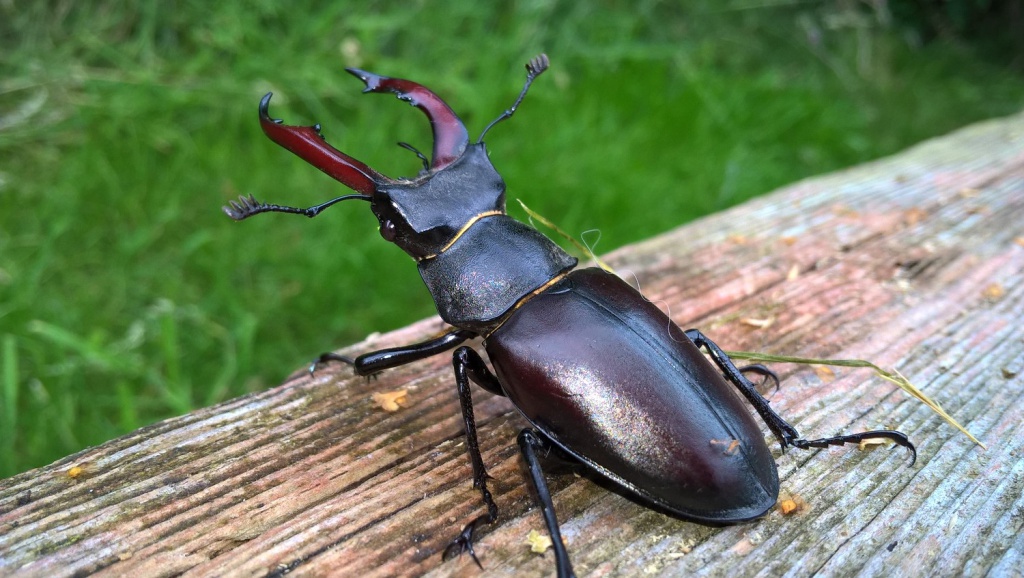
The stag beetle, also known as a horse pincher, thunder beetle, and oak ox, is the largest beetle in the UK and is protected under the Wildlife and Countryside Act 1981, together with being classified as a Priority Species in the UK Biodiversity Action Plan. Its larvae depend on old trees and rotting wood to live and feed on and their favourite habitat is oak woodland, but they can also be found in gardens, parks, and hedgerows. The majority of their lifespan is spent as larvae, which can take between three to seven years to develop before they pupate and transform into adults. In contrast to this long, slow journey, the adults emerge in May with the sole purpose of mating and die in August once eggs have been laid. I can’t help now thinking of the adults as fireworks. All that time in the dark heart of the wood and then a brief whooosh before falling back to earth!

Stag beetle larva, Daily Mail

Stag beetle, Holborough Marsh, truewildlifeblogspot.com

We are most likely to see stag beetles when the beautifully burnished~chestnut males fly on warm summer evenings in search of a mate, or perhaps when they are gathering strength by basking in the sunshine during long summer days. Once they find a female they display their antler-like jaws to her and then use them to fend off rival males, in much the same way that deer stags would do. I love that the ‘way of the deer’ is being played out in layer after layer of life. I was also delighted to find that many of the common names for stag beetles around the world relate to deer. To name a few, in Belgium they are called ‘grande biche’, or ‘great doe’, in Norway they are ‘eikhjort’, or ‘oak deer’, in France they are ‘cerf-volant’, and in Italy ‘cervo-volante’, both translated as ‘flying deer’, in Bosnia they are ‘jelenjak’ and in Macedonia, ‘Elenche’, both meaning ‘little deer’. I am sure that antlered St Elen is watching over these little beetles, just as she does her reindeer and deer.

Stag beetle male & female by Ross Bower for PTES

Interestingly, in Germany, and to some extent in England, they seem to be more often linked with fire, revealing what may be some of their oldest names; ‘feuerschröter’, or ‘fire thresher’, ‘hausbrenner’, or ‘house burner’ (relating to the old superstition that stag beetles came to fires in order to take some to burn down houses), feueranzünder, or ‘fire lighter’, and ‘donnerpuppe’, or ‘thunder puppet’, from the belief that stag beetles were the holy animals of the God of Thunder. These beliefs are also found in England, where it was once said that they could summon lightning or carry a burning coal in their jaws to ‘do the Devil’s work’. I am not so sure about that, remembering that so many holy animals are later demonised, but I am sure that St Cuthbert, who was also known as the ‘Fire of the North’ might have felt much kinship with these small beings. I myself was delighted to find that one of their names in Kent where I live is ‘cherry-eater’!

Image: PTES

As I mentioned above, South and West London provide a vital refuge for our threatened stag beetles. They can also be found elsewhere in southern England, in the Severn Valley, and in coastal areas of the southwest. Elsewhere in Britain they are extremely rare or even extinct. There are several threats to their survival. The rarely seen female stag beetles prefer light soils where they can more easily dig down and lay their eggs. Their larvae spend most of their life below ground, often at depths of up to half a meter. When they emerge as adults they need to be in an environment that allows them to dig their way to the surface. Aside from this they prefer warm areas with low rainfall, and so rain-increasing climate change may prove a challenge for our small stags, with very dry weather adversely affecting the survival of larvae. Their food sources are also becoming harder to find. Female beetles are able to fly but spend most of their lives walking about on the ground until they have mated, which is when they attempt to return to their own birthing ground. If there is enough food there she will then lay her eggs underground in rotting wood, such as log piles, tree stumps, and old fenceposts. The larvae feed on this decaying wood below ground, but it is becoming scarce as many of us become more and more obsessed with having tidy gardens. The adults are unable to eat solid food and rely on fat reserves built up during their larval stage. They are though partial to sipping sap and fallen soft fruit. One of my favourite places in Glastonbury is the Abbey Orchard, where the fruit is often left to fall and rot. I find that process beautiful but remember taking a friend there expecting him to find it beautiful too. Instead, he bemoaned the ‘waste’ of the uncollected apples, found it an ugly, uncared for place. It is a sad world indeed where we see the worth of something only when it is obviously useful to, or wanted by, ourselves. It would be a blessing to the earth indeed if we could shift our way of thinking to see grace in allowing the falling and return of the standing people and their fruits which are of such value to the wild web of life. I very much doubt that those rotting apples were wasted and I’m sure that stag beetles would have loved them.

Fallen apples, Jacqueline Durban, August 2017

Stag beetles are also under threat from predation by cats, foxes, crows, and kestrels, who are able to kill them when they are vulnerable above ground in their adult stage. But the most significant risk to their survival is from habitat loss. Many of Britain’s woodlands were sold for development between the wars. Although the introduction of the Green Belt in 1947 provided some protection, many open spaces in the south-east have now been overdeveloped without giving proper consideration to maintaining wildlife habitat. This despite their legal protection stating that, if stag beetles or their larvae are thought to be present on a site marked for development and they might be disturbed, it is recommended that someone with expert knowledge of their habitat needs is present to make sure that they are suitably relocated nearby. But relocated to where!? In addition the ‘tidying’ of green spaces and the tree surgery practice of ‘stump grinding’ felled and fallen trees has meant that there is little wood left able to rot.

Delicious stag beetle friendly fence post, September 2017

But we should not be too downhearted as increasing awareness has meant that many green spaces, particularly in London, now have a policy of retaining areas of dead wood with the specific aim of attracting stag beetles. I think that one of my favourite scenes in the BBC televsion series ‘Twenty Twelve’, which satirised London’s preparations for the Olympics, was when a meeting was held between the Head of Sustainability and someone from a stag beetle protection group who had visited the Olympic offices to advocate for dead wood being retained in Greenwich Park. He was assured that the organisers had carefully collated a map of all the tree stumps in the Royal Park with a view to retaining them only to find that the marks on the map were wastebins!

Sadly, stag beetles are also directly under threat from us. I have seen two stag beetles in my life, both in South London. One, gloriously, was seen flying in a warn summer evening when I had gathered with a group for a bat walk. I can tell you that we quite forgot the bats, wonderful though they are, when the sight of a whirygig male stag beetle came into view. I thought that he must have been a fairy! The other one was, tragically, squashed on a London pavement. Warmth-loving stag beetles are attracted to tarmac on pavement and road surfaces during the summer and, of course, there they are vulnerable to feet and traffic. Sometimes they are also killed because they ‘look dangerous’, even though stag beetles are very, very rarely aggressive to humans (although if you do ever get into an argument with one then it might be handy to know that it’s the smaller females who have the most powerful jaws!).

Stag beetle female by John Hallmen on Flickr

Despite this, what I do find lovely about the relationship between humans and stag beetles, is that they offer us such an opportunity to offer help and support. In so many ways their proximity to ordinary people holds the key to their continued survival, revealing to us the shimmering web of right relationship that is possible between us and our wild kin. Every year we are becoming more attuned to the needs of our companion stag beetles and they are increasingly loved. Jeweller Emma Keating has even produced a silver stag beetle ornament at the request of her father, which Sir David Attenborough now has on his desk! Each year, PTES (the People’s Trust for Endangered Species) hold a stag beetle survey, the ‘Great Stag Hunt’, with 8155 individuals recorded this summer. And, in 2011, scientists conducted a non-invasive survey which used tiny microphones to listen to stag beetle larvae communicating with one another. They found that the ‘stridulations’, or rasping noises, made by the larvae increased if they were handled or placed in solitary confinement. They also discovered that adult stag beetles find ginger irresistible! Individuals are also speaking out for stag beetles. In the summer of 2015, the local newspaper, ‘South West Londoner’, ran an article entitled, ‘Love Is All They Need’ (get it!?), during which Twickenham resident, Mike Strick made an impassioned plea for mindfulness of these little winged beings.

Stag beetle female by Mike Hargraves for PTES

And so, what can we do to support the stag beetle people? With the countryside and farmland having less and less to offer wild creatures, one of the best things we can do is to provide homes for them in our gardens by providing rotting wood or perhaps a log pile. PTES provide instructions for how to do that here. We can also resolve to leave dead wood and old fence posts alone, avoid blocking potential nest sites by not putting decking or a patio over every bit of bare earth, provide untreated woodchip and mulch, which offers ideal habitat for egg laying and food for larvae, cover water butts and provide escape ramps from ponds, be mindful of predators on summer evenings when the adults might be flying, and avoid mowing our lawns during the time that the adults are emerging from underground. And we can also help to count stag beetle numbers though PTES and the European Stag Beetle Monitoring Network. It seems that often the survival of our wild kin becomes threatened before we have noticed what’s happening. Let’s then surround our ‘little deer’ in a wild web of noticing. With the recent shocking revelation that the numbers of flying insects has plunged by three quarters over the last 25 years, it might help our own chances of survival too.

Silver stag beetle by Emma Keating https://emmakeatingjewellery.co.uk/products/stag-beetle-pendant/

Stag beetle advocate! By Little Chook on Etsy https://www.etsy.com/uk/shop/littlechook

fyeahtattoo.com

Novena for the Fallen Through

Protection, justice, and shining health for our wild kin.

This is a prayer is for the stag beetle people, our little deer.

Blessed Cuthbert,
Beloved Cuddy,
Saint of Salt and Fire,
Antlered ancestor,
Friend of otter, eider, cormorant, and crow,
Walker of the untamed edge of Land and Spirit,
Lover of wild places, wild creatures, and wild grace,
Threader of sea-stars into wild prayer.

We stand in solidarity with you at the roots of the Tree of Life.

We lift a wild and shining prayer
of summer warmth and dreaming dark
for the stag beetle people,
tiny walkers of the antlered road,
dwellers in our nearby wild.

We call upon the Rot Mother to hold them in her care.
Autumn woman, earth woman, soft and yielding, dripping sweetness,
our prayer is for all to see the beauty in decay,
the blessing of return,
so that our little does and flying stags
might be provided food for their larvae
and sweet moisture in their summer mating,
fuel for their flight.

Help us to love the beings of dirt and depth,
elusive detritovores, careful composters,
detritus eaters, decomposers,
recyclers of energy, keepers of the flow.
Blessings on our earthworms, our woodlice,
sister mycelia, sacred bacteria,
the tiny belly-boilerhouse,
harvesting grace in decay.

Blessed Cuthbert,
Beloved Cuddy,
Saint of Salt and Fire,
Antlered ancestor,
Friend of otter, eider, cormorant, and crow,
Walker of the untamed edge of Land and Spirit,
Lover of wild places, wild creatures, and wild grace,
Threader of sea-stars into wild prayer.

We stand in solidarity with you at the roots of the Tree of Life.

We lift a prayer of luminous darkness
for the larvae of our beetle kin,
curled into the hope of transformation,
singing to their egg~mates
through the vanished forest’s heart,
the keening song of wood,
knowing that even the ghosts of fallen trees
can sustain unseen life.

Invisible dreamers, long~sleepers,
teach us metamorphosis,
teach us to shape~shift from indifference to care,
teach us to value what lies underground,
teach us the sounding of soil.

We lift a prayer for the firework~flight of stag,
a burrowing and a nesting prayer for doe,
that their short life in light be sugar-sweet
with sap and sacred meeting.

Oak ox, oak deer,
fairy of our sovereign tree,
diviner of the woodland edge,
thunder-singer, light-bringer,
sun-basker, fire-burner,
ember-carrier, hearth-hunter,
may our love for you grow roots,
catch fire.

Cuddy, Fire of the North,
help us to protect our precious southern flames,
who carry a spark of your blessed name.

Blessed Cuthbert,
Beloved Cuddy,
Saint of Salt and Fire,
Antlered ancestor,
Friend of otter, eider, cormorant, and crow,
Walker of the untamed edge of Land and Spirit,
Lover of wild places, wild creatures, and wild grace,
Threader of sea-stars into wild prayer.

We stand in solidarity with you at the roots of the Tree of Life.

Help us to see that we are the ones that we’ve been waiting for,
that we have the power to turn the tide, to be the change,
for our stag beetle family.
Help us to see our gardens as a privilege and a prayer
as our own tiny patch of wild,
and let them be wild;
summer wild with bare earth for burrowing,
winter wild with dead wood, the mulch of leaves,
the smell of earth returning to earth,
the blessing song of worm,
the sweet snore of hedgehog,
the winter sleep of bee,
and in their presence, find family.

Cuddy, far-walker, maker of pilgrimage,
help us to trust our feet,
help us to know that where we walk is holy ground,
that we might watch each step we take,
and be aware, alive, to beings in our path,
walk lightly on the earth where snails leave silver trails,
where stag beetles make prayers to the sun.
And let the tides of our walking leave only life in their wake.

We ask this in the name of badger and water vole,
hen harrier and natterjack toad,
red fox and red deer,
dotterel and dormouse,
red squirrel and seal.

Of starling and sparrow,
sand lizard and slow worm,
hedgehog and hare,
corn marigold and marsh cleaver.

Of great crested newt and small fleabane,
ringed plover and oystercatcher,
pasque flower and mountain ringlet butterfly,
wildcat and skylark.

Of marsh fritillary butterfly and shrill carder bee,
blue ground beetle and white-clawed crayfish,
freshwater pearl mussel, cormorant, and crow.

Blessed Cuthbert,
Beloved Cuddy,
Saint of Salt and Fire,
Antlered ancestor,
Friend of otter, eider, cormorant, and crow,
Walker of the untamed edge of Land and Spirit,
Lover of wild places, wild creatures, and wild grace,
Threader of sea-stars into wild prayer.

We stand in solidarity with you at the roots of the Tree of Life.

May the stag beetle kin thrive,
may they teach us gentleness in seeming fierceness,
to not judge by appearances, to love the unfamiliar.
In following the tracks of the little deer people,
may we weave a web of noticing,
shimmering threads of right relationship,
woven with the family of all beings.
And in that weaving let there be
a mending between human and wild,
a knowing that we can take communion with life,
that we can be forgiven, make amends.

The first is for badger.
The second is for hedgehog.
The third is for Sheffield’s street trees.
The fourth is for otter, cormorant, and seal,
for salmon, and elver, and eel.
The fifth is for shark and orca,
the sixth for stag beetle.
May our string of prayer beads,
formed in the starry sea where all things are one,
gathered on the shore of meeting,
be filled with life, love, and wild justice
for all beings on this earth we share.

For this we pray.

Aho mitake oyasin, amen, blessed be. Inshallah.


Image: Katherine Strick for South West Londoner 

References and information:
Stag beetle and other information ~


http://www.brc.ac.uk/DBIF/homepage.aspx Database of insects and their food plants


http://maria.fremlin.de/stagbeetles/nomes.html vernacular and dialect names for stag beetles


http://www.wildlondon.org.uk/sites/default/files/files/Stag%20beetle%202011%20survey.pdf


How to help stag beetles ~


https://ptes.org/get-involved/surveys/garden/great-stag-hunt/stag-hunt-survey/


https://ptes.org/press-release/ ~ make garden stag beetle friendly