Showing posts with label seasonal living. Show all posts

Tuesday, 24 November 2020

Stirring up Cattern Cakes & Community ~ for Celtic Advent.

The Sunday before ‘Church Advent’ begins is always Stir-Up Sunday, and this year that fell on 22nd November. I wrote all about Stir-Up Sunday last year and you can read that post here if you would like to. 

Stir-up Sunday, which has become associated with the making of Christmas puddings and cakes, in fact takes its name from the opening words of the collect of the day in the 1594 edition of the ‘Book of Common Prayer’; ‘collect’ being the name for a short prayer that gathers up the theme for a particular day in the Christian liturgy; 

“Stir up, we beseech thee, O Lord, the wills of thy faithful people; that they, plenteously bringing forth the fruit of good works, may of thee be plenteously rewarded; through Jesus Christ our Lord. Amen.” 

Medievalist Eleanor Parker, who writes as ‘A Clerk of Oxford’, tells us that “Several Advent collects begin with the Latin verb 'excita', which means 'rouse, excite, stimulate'. The translation 'stir up' has a nice energy about it, but a medieval English prayer offers the translation 'Egg' (as in 'egg on'), which also has a pleasing culinary flavour…” 

Indeed, a translation of an Advent collect from Worcester Cathedral begins, “Egg our hearts, Lord of Might”, which brings us beautifully to another meaning of ‘Stir-Up Sunday.” 

Because the ‘stir-up’ prayer came with the specification that it "shall always be used upon the Sunday next before Advent”, and, as most Christmas pudding recipes require the pudding to be kept for several weeks to mature before eating, it acted as a fine reminder that the time had come for pudding making; which certainly brings a different meaning to ‘bringing forth the fruit of good works’! 

And there were other interpretations of the day too. Victorian schoolboys, who were excited by the thought of the imminent Christmas holidays, took the day as an invitation to ‘stir it up’ by pinching and poking one another. We are told that ‘Crib Crust Monday’ and ‘Tug Button Tuesday’ offered similar opportunities to the rosy-cheeked schoolboy, with ‘Pay-off Wednesday’ being the day to repay small grudges in playful fashion! 

The Sunday before Advent is now more usually celebrated as ‘The Feast of Christ the King’, which was first celebrated in 1925, and so I thought that I would share this poem by Malcolm Guite, which warns us against the consumerism so deeply woven into the modern lead-up to Christmas; 

Christ the King 

Matthew 25: 31-46 

Our King is calling from the hungry furrows 

Whilst we are cruising through the aisles of plenty, 

Our hoardings screen us from the man of sorrows, 

Our soundtracks drown his murmur: ‘I am thirsty’. 

He stands in line to sign in as a stranger 

And seek a welcome from the world he made, 

We see him only as a threat, a danger, 

He asks for clothes, we strip-search him instead. 

And if he should fall sick then we take care 

That he does not infect our private health, 

We lock him in the prisons of our fear 

Lest he unlock the prison of our wealth. 

But still on Sunday we shall stand and sing 

The praises of our hidden Lord and King.

(Malcolm Guite) 

As an antidote to that consumerism Stir-Up Sunday invites us to gather with our families around the kitchen table and stir wishes into sweet puddings and cakes. That many of us are unable to do that this year even if we should want to is difficult indeed. 

Last year, I ended my blog on Stir-Up Sunday with a promise to invite my neighbours to the hedgehermitage kitchen this year to stir our pudding mix. But, of course, that too has not been possible with Covid-19 so present in our every day. Imagine then my delight when I visited the gathering place of the Little Church of Love of the World community (of which more on another day), the Wild Goose Collective, on the evening of Stir-Up Sunday to find an array of sharings informing me that many of our number had taken the opportunity to bake Cattern cakes, the traditional food of Catterntide, which falls on 25th November. As I had been doing the same, and as Catterntide is almost with us. I thought that I would share my recipe for Cattern cakes, which is based on an almost unchanged Tudor recipe and comes from the legendary ‘Cattern Cakes and Lace: Calendar of Feasts' by Julia Jones and Barbara Deer. 

This is my third year of making them and they are always delicious. You can read about last year’s Cattern cake-making adventure here

As last year, I recommend the use of an ancestral 1970s apron and gorgeously garish carboot sale rolling pin, but if you don’t have those you can proceed with what you have. Cattern cake recipes are very forgiving.

Here's the recipe. 

Ingredients: 

9oz self-raising flour (sieved) 

1/4 tsp ground cinnamon ~ I use 2 tsp and add some more later on, but I do have a great love of cinnamon. I advise bold experimentation. 

2oz currants 

2oz ground almonds 

2 tsp caraway seeds ~ or, as with the cinnamon, add a bit more. 

6oz caster sugar 

4oz melted butter 

1 medium egg, beaten 

Extra sugar & cinnamon for sprinkling

The recipe can be easily adapted for different dietary requirements. For example, Jan Blencowe of the Wild Goose Collective swapped the self-raising flour for Paleo flour with a heaped tsp of baking powder, substituted flaked almonds for the ground almonds, and used powdered stevia rather than caster sugar.

Method: 

Sieve the flour into a bowl and mix in all the other dried ingredients. 

Add the melted butter & beaten egg and mix to form a soft dough. I also added a tiny bit of warm water. 

Don't forget to lick the spoon!

Roll the dough out on a floured surface until you have a rectangle, approx 10 x 12 inches. 

Brush the rolled out dough with water and then sprinkle with cinnamon (lots!) and sugar. 

Gently roll, as you might for a swiss roll. It doesn't need to be too tight. 

Cut into approx 2cm wide slices and pop on a baking tray, leaving space in between to allow them to spread a little. Bake in an oven preheated to 200°c/Gas Mark 6 for about 10 minutes, or until golden and crispy on the top. Mine took about 25 minutes! Bask in the loveliness as your house fills with the smell of spices and good things. 

Remove your cakes from the oven & pop on a wire rack to cool. You can sprinkle on some more caraway seeds at this point, and even more sugar & cinnamon if liked. 

Once cool, they can be stored in an airtight container for up to 7 days but I can almost guarantee that they won’t last that long. Although I made a large batch of Cattern cakes on Stir-Up Sunday I have already had to make more so that I have some for Cattern Day on Wednesday! 

Traditionally, these cakes would be enjoyed with a 'hot pot' mixture of rum, beer, and eggs, but, so far at least, we have stuck to tea here in the hedgehermitage. Absolutely lovely too. 

Do let me know if you decide to make them.

As for stirring wishes into the mix, this Stir-Up Sunday I chose wishes for creativity,  community, love, and fierce resistance to the dying of the Light. In the year ahead I will do all I can to make sure that my wishes come true.


Thursday, 13 February 2020

Raising End of Winter Spirits ~ Making Gin Alexanders

Foraging basket with Alexanders

I have dipped one toe into my first gentle forage of the year; gathering Alexanders leaves from the hedgehermitage garden to make a flavoured gin; so easy that even I can emerge from my end of winter nesting to make it happen.

Foraging is perhaps my favourite thing to do; it is mindful, creative, it helps me care for my body (both because it involves walking & because it offers me healthy things to eat), but most of all because it creates a relationship & an intimacy with the land and the plant people, especially those close to home.

But I must admit that part of me resists foraging at all because, once I put my foot on the helter skelter ride of gathering, time becomes a different thing. I am a terrible procrastinator but there is very little room for doing-it-tomorrow with plants. They move so quickly from one stage to another that the prized petal, leaf, seed, or berry, can be gone before I've even picked up my foraging basket. So much longing waiting for their return, so much sitting with patience waiting for the right time, and then whoosh and they're gone! It really gets me in touch with what's real, and with what endures for all its ephemeral cycles.

There have been years when I've missed the spring cleavers, most of the nettle seeds, the rowan berries, & I dream of them all winter and still regret not being braver, or more present, or less world weary. But, when it works, it is also precious to live by something other than chronos, the worldly time of clocks & four walls; to step into the flow of kairos, the sacred time of sunlight, moon cycles, seasons, & the ebb & flow of growth. To be swept along by the generous tide of green is a gift to be cherished.

Alexanders, also known as black lovage, wild celery, & horse parsley, are almost ever-present in our garden but they are particularly lovely in the spring when their young leaves are pulsating with new growth and, a little later, when their green-gold flower heads are beginning to open. I also love them in the winter when they turn to dry stalks topped with shiny black seed heads.

Alexanders seedheads
They look beautiful and the tiny birds love to use them as perches. They are all leaves at the moment though and have almost entirely obliterated our garden bench!


The Romans called this stately green being 'Parsley of Alexandria' & introduced it to Britain as a pot-herb where it has thrived, particularly on the coast, which is why we have so many here. Although it was brought here primarily as food (its flowers can be steamed or eaten raw in salads, & its sprouts, buds, & tops  blanched all year round, together with its spring stalks, its black seeds can be ground & used like pepper) it has been used as medicine since ancient times & was eventually planted in medieval infirmary gardens. It can still be found growing in monastic ruins. Originally, it is native to wild Macedonia, the birth place of Alexander the Great.

A possible over-abundance of Alexanders
in the hedgehermitage garden 

As a medicinal herb the juice of Alexanders' roots & seeds have been used on cuts & wounds, & its bruised leaves used to stop bleeding. Its seeds soaked in wine were used to stimulate menstrual bleeding, & its leaves eaten against scurvy. The leaves were also said to 'sharpen the appetite'. That it helped with digestion was one reason for its inclusion, with nettles & watercress, in 'Lenten pottage', a gruel eaten in Ireland during Lent up until the 18th C, which was believed to ease the 'viscous humours' gathered in the stomach through the over-consumption of fish.


And so I pottered with my basket in the garden collecting Alexanders; they are wild & so to me that definitely counts as foraging. And we have SO many this year that gathering some feels essential! It is important though to be sure of identifying Alexanders correctly, as they are a member of the Umbellifer family which includes the highly poisonous Hemlock Water-Dropwort, although that is always found growing close to water. But there are others, like Hemlock, which it might be confused with. As I say, foraging builds relationship and the deeper that relationship is the better our ability to identify plants from their sisters.

Gathering these Alexanders I had to be particularly mindful as this year many of the plants have rust fungus (Alexanders rust, Puccinia smyrnii), which I celebrate as a being but don't really want in my gin.

Alexanders rust fungus


I was pleased with the leaves I did find though, & I feel more connected to the garden after the long winter months.


Having gathered the leaves, I carefully checked & washed them before slightly crushing the stalks (a bit of guesswork there but they smell lovely).


I then packed them loosely into a mason jar which I topped up with gin. You can also add sugar for sweetness at this point but I felt that I wanted to keep the pure flavour of the Alexanders as we move into spring. I'll leave them for three weeks or so & then strain them. I'm hoping that it will make a delicious spring tipple. So exciting!


Solid Dennis helped with my Alexanders gin making too, although to be honest his attention span wasn't all that...


To read more about Alexanders & using them to flavour gin pop to these links:

https://www.wildfooduk.com/edible-wild-plants/alexanders/

https://www.edenproject.com/learn/for-everyone/edible-wild-food-alexanders

https://www.google.com/amp/s/amp.theguardian.com/lifeandstyle/wordofmouth/2011/dec/07/how-to-make-gin-alexanders


Thursday, 9 January 2020

To Spin a Saint ~ Distaff Day for Epiphanytide

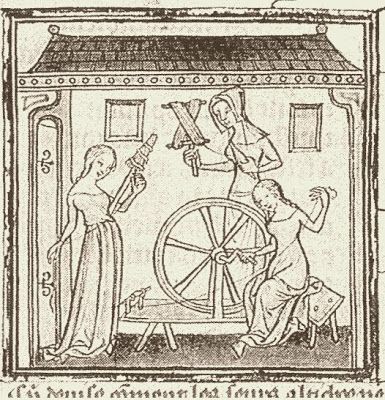
Medieval spinning

The first Monday after Epiphany is known Plough Monday and was traditionally the day when agricultural workers, mostly male, returned to work after the Christmastide festivities. But it's less well known that there is also an equivalent day for women and women's work; Distaff, or St Distaff's, Day, which takes place each 7th January.

Spinning, the process by which raw fibre, such as wool or flax, is made into thread which later becomes cloth, traditionally requires two main tools; the distaff and the spindle. The spindle, variations of which date back to Neolithic times, is a straight spike onto which the fibre is twisted, and the distaff, also called a roc or rock, the tool used to hold the unspun fibres so that they can be teased onto the spinning spindle. To control both requires tremendous co-ordination. And this was work almost exclusively done by women.

Queen Berthe teaching girls to spin flax using a distaff, Albert Anker, 1888

Bringing our attention back to Epiphany stars, in Norse mythology the goddess, Frigg, is said to spin clouds from her sparkling distaff in a star constellation known as 'Frigg's Spinning Wheel' (also Friggerock or Orion's Belt).

Frigg with her distaff

Prior to the Industrial Revolution (1760-1820 approx), spinning, along with weaving and sewing, were primarily jobs of women and undertaken in the home. All three provided clothing and other essentials for their community and also enabled them to care for children at the same time. By the 1300s 'distaff' had become a word for women's work, and for women's concerns in general. Chaucer was the first to record this useage in his 'Canterbury Tales', as did Shakespeare in 'King Lear'.

So intimately associated was the distaff with women's work that it had soon become a word for women themselves. By the 1500s, it had come into use to describe the women of a family; hence the phrase, the 'distaff side', meaning the female side, or the motherline.  There is even a collection of French folk beliefs which relates the wisdom shared amongst late medieval women whilst spinning. Published in 1480, this collection's name translates to, 'The Distaff Gospels'.

Spinning remained deeply connected with the domestic sphere even after the Industrial Revolution, for a while at least. The early spinning machinery, such as the 40 spindle jenny, was relatively affordable for cottage workers.  It was only later, when new inventions, such as the spinning jenny water frame, became too costly or too large, that spinning fell into the hands of industrialists and investors.

The majority of textile workers at this time were women, but now children, including many orphans, were also employed as their small size made them more agile in working the machinery. They would work 12 to 14 hour days, six days a week with only Sundays off, & often for poor pay. Many of the women would only take work in the factories seasonally when they could find scant work on the land. In this way relationships, with both communities and place, were slowly broken down.

And so we come to St Distaff's Day. Often when researching folk traditions we might find that their origins are in the 18th Century, and the move to towns and cities which threatened to break connection to the deeper tides of land and season. For example, many of our much beloved May Day traditions, such as the Jack in the Green, began in cities at that time, albeit with their roots in much older traditions.

Some might be disappointed by this, and often we tie ourselves in knots trying to prove that something is older than it is as though somehow that makes it more worthy. I celebrate it. To me, this is evidence that our impulse to belong, to build relationship with landscape & home is innate, primal. If it is suppressed or stamped out by Church or by State in one way it will only bubble up in another. You can't kill the Spirit!

We no longer remember why we considered it good to make offerings to the waters, but we continue to throw coins into wishing wells. When compelled to leave land that our families have lived on for generations to work in factories far from what and who we know, our reaction is to take the decorated milk pails carried by milk maids in May Day processions and make them more, turn them into a mass of leaves wearing a flower crown, the absolute essence of everything green and untamed. And  then we dance our wild Jack around dirty streets as though we were in the familiar village where our great-great-great-grandparents fell in love and planted trees. And so we are, because this is sacred space. This is holy ground, because we make it so.

The land is not just something we live on; discrete, separate. We carry it inside us. We have hope, we carry our stories no matter what the provocation to abandon them, we transcend our circumstances, and we find meaning where meaning seems impossible. This is what it means to live in sacred time, and this is exactly how we will survive the next five years of Conservative rule.

But St Distaff's Day, like Plough Monday, is older. Always held on 7th January, this was traditionally the day when women returned to their spinning after Midwinter. But it was also a resistance to becoming immediately subsumed in work, allowing the trickster spirit of the Christmas period to have one last outing. On Distaff Day the men, themselves not yet returned to the plough, would often try to steal the women's flax and, in response, the women would attempt to soak the men from head to toe with water! And if Plough Monday and St Distaff's Day happened to fall on the same day festivities would be even more raucous.

St Distaff's Day festivities, Mary Evans Picture Library

In the 17th Century, lyric poet and cleric Robert Herrick wrote of the tradition in his poem, "St Distaff's Day or the Morrow After Twelfth Night":

Partly work and partly play 
You must on St. Distaff’s Day: 
From the plough soon free your team; 
Then come home and fother them; 
If the maids a-spinning go, 
Burn the flax and fire the tow. 
Bring in pails of water then, 
Let the maids bewash the men. 
Give St. Distaff all the right; 
Then bid Christmas sport good night, 
And next morrow every one 
To his own vocation.

And spinning truly was a vocation, not only involving skill but many hours of repetitive work; one pound of raw wool could take a week to spin, and raw cotton even longer. It was a task undertaken by women of all classes, rich and poor alike, and often in the company of other women ~ before the spinning wheel the tools and raw materials needed were easily portable and so it was possible to finish daily domestic tasks and then gather to spin in the evening, and using methods employed since the earliest times; there are images from Ancient Egypt showing women spinning in exactly this way with a distaff and spindle.

Women spinning, 1500s, Pinterest

We are entering again the female space of winter. Here we find Catterntide, a celebration for lacemakers, on November 25th as we begin our journey, the Anglo-Saxon 'Mõdraniht', or 'Mothers' Night', on Christmas Eve, Mary birthing the Christ child, the Mari Lwyd; the 'Grey Mare' of South Wales, at Midwinter, Women's, or Little, Christmas on 6th January, and Distaff Day & the work of spinning on 7th January as we emerge (we might also trace 'male space', from Martinmas to Plough Monday, but more of that soon).

St. Distaff Day was also a time to honor 'mother’s spit'. Mother’s spit was an important ingredient in flax production, wetting flax fibres with saliva, which contains an enzyme that decomposes the cellulose of the flax into a sticky substance & so helps splice the threads together into yarn.

Records of St Distaff Day begin in the 14th Century, or the Late Middle Ages. It was during the Later Middle Ages that the woollen industry became the major source of income for many, with huge swathes of land dedicated to sheep farming. This was also the time when spinning moved from the domestic sphere; making yarn for use by family and close community, into being a marketable commodity. But these were the years of the Great Famine of 1315 to 1317,
the Black Death, which reached England in 1348, the Hundred Years' War with France; events which killed almost half of England's population and caused economic chaos and the unravelling of the old social order. No wonder that both women and men felt the need to 'draw the line'.

During this time nearly 1,500 villages were deserted and men and women were forced to look for work in towns and cities. Accompanying social unrest brought events such as the Peasants' Revolt of 1381. As an aside, Mr Radical Honey occasionally buys his fine English fellow's apparel in Canterbury from a the great-great-great-etc-etc-grandson of Wat Tyler, and although he works in a very traditional gentlemen's outfitters he definitely has something of the rebel about him!

In the midst of this social upheaval came St Distaff's Day; an acknowledgement that women's work must be done, but also a reminder that we are more than the work we do, more than our usefulness to the economy. There are relationships to be maintained, lines to be drawn between workers and those who benefit financially from that work, lines that everyone is supposed to know about. That the day was dedicated to a saint of course added credence to the determination not to work, or not too hard at least. Saints Days were for feasting, or for its sister fasting, but folk saints' days always fall on the feasting (and drinking) side.

But there is no 'Saint Distaff'. This is yet another example of an 'unofficial saint's holiday' designed to increase the potential for merrymaking. And merrymaking is Resistance. All the same I think that we might confer sainthood on a tool which has so benefitted us for millennia; especially one that holds a chaotic tangle of raw material and allows us to make sense of it; a saint to help us with that work would be welcome indeed.

Observance of St Distaff's Day continued for almost five centuries until the Industrial Revolution took the work of spinning into factories, dividing the women from the men, and moving work from the domestic cottage industries where one could manage one's own time into a sphere and time which was no longer one's own. When work is done by the clock there is no space for a day of merrymaking to get used to the idea of Christmas ending. And we might hazard a guess that the loss of the full Twelve Days of Christmas festivities, symbolised by our traditional 'Twelfth Cake' becoming a cake for Christmas day, meant that women would have returned to work well before St Distaff's Day.

We might celebrate then that Distaff Day is returning as more of us become interested in our old festivals and celebrations; some without quite knowing why, some to honour where we've come from, some as an act of conscious Resistance to the strangle hold of secular time and space.

St Distaff's Day flyer 

St Distaff's Day is the perfect time to gather with others for a post-Christmastide creative afternoon but also, in this time when we are so divided from those who provide us with our material comforts, to consider the lives of the people who make our clothes, often under exploitative and unsafe conditions and with low wages in countries where rules protecting workers are non-existent. We might reflect upon who is doing the 'spinning' now, and are WE the ones who the Resistance must be against? I pray to St Distaff to help us all make better choices in the year ahead.


And here, it comes to me, is the perfect tune to accompany us on these 'wild saint days of Resistance'!


Go on and speak your mind, 
lets find out what it is you have to say 
I hope nobody turns away 
You said it loud and clear; 
We have to work, 
we have to earn our way 
well I'm sorry not today 
Oh I'm sorry not today 

 Truth is if I dont make it, 
then you cant take it 
and if I dont sew it 
then you cant wear it 
truth is if I dont grow it, 
then you can eat it 
And if I dont aim it, 
then you cant shoot it 
It's that little bit left over at the end...

(The Levellers)

We will reclaim this world; not through force but by making holy; one thread, one stitch, one seed, at a time.

References:

St Distaff's Day ~

https://www.ingebretsens.com/blog/on-the-close-of-st-distaff-day/

https://www.tudorsociety.com/happy-st-distaffs-day/

http://www.thebookofdays.com/months/jan/7.htm

http://www.tellinghistory.co.uk/resources/distaff.htm

https://norfolktalesmyths.com/2019/01/02/who-believes-in-st-distaff/

Spinning ~

https://en.m.wikipedia.org/wiki/Spinning_(textiles)

http://spinning-wheel.org/about1/

On 15th Century spinning techniques ~

https://15thcenturyspinning.wordpress.com/2012/06/16/how-did-women-spin-in-the-15th-century/

http://medievaleuropeilluminated.blogspot.com/2017/10/spinning-through-time-distaff-and.html?m=1

The Distaff ~

https://en.m.wikipedia.org/wiki/Distaff

https://www.merriam-webster.com/words-at-play/distaff-meaning

The Spindle ~

https://en.m.wikipedia.org/wiki/Spindle_(textiles)

The Middle Ages ~

https://en.m.wikipedia.org/wiki/Late_Middle_Ages

https://en.m.wikipedia.org/wiki/England_in_the_Middle_Ages

https://en.m.wikipedia.org/wiki/England_in_the_Late_Middle_Ages

The Industrial Revolution ~

https://en.m.wikipedia.org/wiki/Industrial_Revolution

https://en.m.wikipedia.org/wiki/Textile_manufacture_during_the_British_Industrial_Revolution

Women's Christmas ~

https://en.m.wikipedia.org/wiki/Little_Christmas

https://www.irishcentral.com/roots/womens-christmas-nollaig-na-mban-celebrate-ireland


Tuesday, 26 November 2019

Making Cattern Cakes ~ Celtic Advent Day 9


Cattern cakes, 2019

I am just in the midst of writing about Catterntide, which falks on 25th November, for Celtic Advent but, whilst we're waiting, I thought that a spot of seasonal baking might be nice.

Solid Dennis takes charge 

My main Catterntide activity, once I had removed our lodger Solid Dennis the cat from my recipe book, was to make Cattern cakes from an, almost unchanged,Tudor recipe.

These were traditionally made by English lace makers to celebrate St Catherine's Feast Day, of which more shortly.


The cakes are delicious; caraway is a much underused ingredient I feel, & Mr Radical Honey has declared them his favourite cake, biscuit, biscuit/cake hybrid, things ever!

Here's the recipe.

Ingredients:

Ancestral 1970s apron and carboot sale rolling pin (optional)

9oz self-raising flour (sieved)

1/4 tsp ground cinnamon ~ but that is nonsense. I put in a whole teaspoon & added even more later!

2oz currants

2oz ground almonds

2 tsp caraway seeds

6oz caster sugar

4oz melted butter

1 medium egg, beaten

Extra sugar & cinnamon for sprinkling

Sieve the flour into a bowl and mix in all the other dried ingredients, plus extra cinnamon on top!


Add the melted butter & beaten egg and mix to form a soft dough. I also added a tiny bit of warm water.


Roll the dough out on a floured surface until you have a rectangle, approx 10 x 12 inches. Mine was smaller than that due to lack of space but I still achieved delicious cakes so do not fear.

Brush the rolled out dough with water and then sprinkle with cinnamon (lots!) and sugar.

Gently roll, as you might for a swiss roll. It doesn't need to be too tight.

Cut into approx 2cm wide slices and pop on a baking tray, leaving space in between. I find that these spread a lot whilst cooking and mine joined together, but it was easy enough to separate them.

Bake in an oven preheated to 200°c/Gas Mark 6 for about 10 minutes, or until golden and crispy on the top. Mine took about 25 minutes! I had to go out at this point so I left Mr RH in charge. He is a diamond geezer. If you don't have one of those probably best not go out at that stage.

Remove from the oven & pop on a wire rack to cool. You can sprinkle on some more caraway seeds at this point, and even more sugar & cinnamon if liked.

Store in an airtight container for up to 7 days, or send to Mr Radical Honey c/o the hedgehermitage.


Traditionally, these cakes would be enjoyed with a 'hot pot' mixture of rum, beer, and eggs, but tea is just as lovely.

Do let me know if you decide to make them.


Recipe taken from 'Cattern Cakes & Lace: a Calendar of Feasts' by Julia Jones and Barbara Deer.

Monday, 9 April 2018

Of Hares & Hock-days ~ Turning Spring Upside Down

I haven’t written anything here for far too long, and that is something that I hope to remedy in the weeks ahead. However, as sharing more about our idiosyncratic seasonal festivals and observances, and therefore perhaps offering an invitation to more deeply ground in our land and who we are, is one of the things that I very much hope to do, I didn’t feel that I could miss the opportunity to write about Hocktide.


Hocktide was an English medieval festival, part of the marking and turning of our agricultural year. These Hock-days fall on the Monday and Tuesday after Easter week and, together with Whitsuntide in May or June and Yuletide in December, mark a pause in the farming year. During this period ‘villeins’ or tenant farmers, who were tied to the land as part of the feudal system, were freed from working on the lord of the manor’s land and also on their own. These ‘bonded tenants’ had more rights than they would have done under slavery but were ‘bound to the soil’ and unable to leave the land without the landowner’s consent. In return for a small rented home, with or without land, they were required to work on their lord’s farmland, often in addition to paying a rent of money or goods. They were also subject to a range of legal restrictions and responsibilities, which might be a heavy burden indeed. For instance, they might have to pay a fine if their daughters married outside the manor or if their sons inherited land elsewhere. The term ‘villein’ comes from the Latin ‘villanus’, meaning a man working at a large agricultural Roman villa estate, a ‘forced employment’ which originated in a decree issued by the Emperor Diocletian to prevent peasants fleeing the land and so causing a decrease in food production. The decree meant that peasants had to be recorded on a local register and could only leave their village to deliver a message or go to war with their master. And so the land became a prison, rather than a home and source of freedom. Despite this villeinage ensured access to land and land meant survival. It was certainly a preferable arrangement to that of the landless labourer, whose position was much more precarious. Nevertheless, villeins were considered ‘lesser’ and so the word became the source of our derogatory term, ‘villain’, which is certainly not a label that many of us would hope to attract.

As for Hocktide, its origins are unclear but there is an enduring tradition that it commemorates the driving out of the Danes on St Brice’s Day, 1002 following Danish raids on England every year from 997 to 1001. In response King Aethelred “ordered slain every Danish man that was in England.” Although this action led to swift revenge, the inhuman behaviour of the Danish invaders meant that any victory against them was worth marking. It is sensible when considering the origin of the festival to note though that St Brice’s Day is in November and that Hocktide is firmly tied to Easter festivities! That it is thought to be related to the pushing back of the Danish invasion may be due to a Hock Tuesday play once put on in Coventry during the sixteenth century which told the story of a group of feisty Anglo-Saxon women who had turned back the Danes after their menfolk had been defeated. These plays were frowned upon by Protestant reformers and so were stopped, although, in 1575, supporters did succeed in putting on the play before Elizabeth I, who is said to have thoroughly approved.

Anglo-Saxon dress, http://world4.eu/anglo-saxon/

The name Hocktide may originate in the German, ‘hocken’, which means, to ‘attack’, to ‘seize’, or to ‘bind’, and certainly the principal day of the festival was known as ‘Binding Tuesday’. Whereas, Hock Monday was for the men, Hock Tuesday was for the women (echoing the winter festivities of St Martin’s Day, or Martinmas, for men, and St Catherine’s Day for women in November). Reversing the activities of Monday, Hock Tuesday’s shenanigans principally involved women, with much merrymaking, ambushing men via the method of stretching ropes across the public highway, and holding them to ransom until a small fee was paid to be put to ‘pious uses’ (or more often perhaps to buying food and drink for the revellers). In 1497, 13s 4d was gathered by women on ‘Hob Monday’ in the parish of St Mary-le-Hill, London, and, in 1607, women went ‘a-hocking’ in Chelsea and raised 45/-. The Lambeth Book, amongst other references to Hocktide payments, records that in, “1556-1557. Item of Godman Rundell's wife, Godman Jackson's wife, and Godwife Tegg, for Hoxce money by them received to the use of the Church." Indeed at one time records from Lambeth reveal hock money as being the single largest source of Parish income. It is also worth noting that the women collected a lot more money than the men!

                                 "1499. It. rec. of hok money gadereyd of women 20s
                                   It. rec. of hok money gadereyd of men 4s
                                  (St Leonard's church, Reading) 
                                           ~ Dictionary of English Folklore

Eleanor Parker, in her book, ‘Dragon Lords: the History and Legends of Viking England’, describes Hocktide as a sort of ‘post-Easter festival of misrule’, or the World Turned Upside Down, which is a thread running through many of our folk traditions. Certainly it allowed the people of the land to have a day or so away from their serfdom if nothing else. She goes on to say that it was first recorded in London in 1406 and grew in popularity over two centuries, before almost entirely dying out by the end of the seventeenth century. The Bishop of Worcester had banned Hocktide revelries in 1450 so it is clear that it took the common people some time to submit to his instructions. Many of the historical references remaining in relation to Hocktide consist of complaints relating to disorderly conduct and this may explain both why the tradition was frowned upon, and why it was so popular!

(anothermag.com)

I have also come across references to Hocktide being more directly related to Easter traditions through the custom of 'heaving', during which one report claims that local people lift one another off the ground whilst singing, "Jesus Christ is risen again!" Whether this is true I don't know but tradition is a wild being and will change and adapt to the times. That Hocktide may come from the feistiness of Anglo-Saxon women fighting off the Danes, or from the period of the agricultural year given to the collection of rents and making of contracts, or from Christians lifting one another off the ground to celebrate the Resurrection, is part of the glorious nature of our traditions, and it may be one, none, or all of these. We must perhaps listen to the earth beneath our feet to work that out.

Although Hocktide revelleries have dwindled in most places, it remains very much alive in Hungerford on the Berkshire/Wiltshire border, where it is celebrated as ‘Tutti-day’ and confined to the Tuesday of the week after Easter. Early on Tutti-day, following a ‘watercress supper’ the previous evening, the Bell Man, or town crier, goes about the village gathering all commoners to a ‘court', which they will be fined a penny for not attending. If they were to refuse they might also run the risk of losing important privileges granted for free grazing, watercress collection, and salmon fishing on the River Kennet. These privileges relate to land granted to those living in certain houses and dating back to the late 1300s. These are the ‘commoners’ and at hocktide the court and jury elect from amongst them Hocktide officers for the year ahead. It is interesting to note that one of the most important dates of the agricultural year was Lady Day on March 25th. From 1155 until 1752 Lady Day was the English agricultural New Year and it was when rents were due and new contracts were made for the year ahead. A vestige of this remains in the UK’s tax year, which begins on April 6th (Lady Day but adjusted for the 10 day difference between the Julian and Gregorian calendars).


Returning to Hungerford, just before the court sessions, the Tutti, or ‘Tithing’, Men (who might also be women) set out around the village wearing top hats and tails and with long poles decorated with spring flowers, blue ribbons, and with an orange on top (said to relate to William of Orange discovering that he was to be king whilst staying in Hungerford). Over the following twelve hours, they endeavour to visit every common rights household and exact yearly tithes. These dues are most usually paid by a penny from the men and a kiss from every woman in the household, who are then gifted with an orange. These are carried by the ‘Orange Scrambler’ who accompanies the Tutti Men with a sack of oranges and pheasant feathers in his hat! They might then be offered a drink before going on their way. In Yorkshire, children were still celebrating ‘Kissing Day’ into the 1950s and this is thought to have perhaps been a remnant of older Hocktide traditions. Certainly the Hungerford Hocktide revelries are accompanied by excited children hoping for sweets.

At lunchtime in Hungerford everyone gathers at the Town Hall for speeches and reports, following which 'the Blacksmith' appears for a ceremony known as the ‘Shoeing of the Colts’. These ‘colts’ are newcomers to the town or to the lunch who are grabbed so that the Blacksmith can hammer a nail into one of their shoes! Traditionally, he will continue hammering until the colt yells “Punch!” and agrees to buy a round of drinks for those present, although it is now considered sufficient to pay only a small token to avoid sending anyone into poverty. One witness reports that he, having attempted to leave the lunch and thus being suspected of trying to avoid being shoed, had been set upon; “I was grabbed on one side by the vicar and struggled for all my worth kicking and was turned upside down with my feet flailing in the air at which point the vicar jumped on my chest and I was laying on the floor…with the sound of the horse shoe into my foot I shouted punch although it was difficult to remember to say this as I was laughing so much.” Following this sombre and ancient ceremony the company then adjourn to a nearby hotel for anchovies on toast! Researching these traditions, I must say that it is easy to draw the conclusion that Monty Python could only really ever have come out of England.

(BBC)

Hocktide it seems is a tradition that is only just hanging on, and yet where it remains it is thriving as a celebration of commoners rights, community, and connection to place. In its more ancient form, it can be included in the myriad folk traditions of this land in which power relations are subverted or turned on their heads, not least because it gave those who were tied to the land by a contract with their lord a few days of relative freedom, a hint of the breaking of chains. That Hocktide's possible roots in the tale of a group of Anglo-Saxon women taking on Danish invaders and winning has been discredited should not necessarily dissuade us from acknowledging Hocktide as a time when gender relations are ‘turned upside down’, with women gaining the upper hand on Hock Tuesday. That this comes at a time when female brown hares are to be seen in our fields ‘boxing’ in order to test the merits of would be suitors is pleasing. 

Here is just one response to Hocktide that I will embrace, no matter how 'historical', or not, it may be...

On this day we honor
The Saxon women who turned away
The attacking Norsemen from the sea
When their menfolk had failed
Or been slaughtered, their bones lying
In graves still fresh and bare.
For when the need arises,
Anyone can find the courage
To face what must be faced
To dare what must be dared
To fly in the eye of the storm
Heedless of life or death.
We honor the spirit in women,
For millennia put down and buried,
But that rises when in need,
And shows its brave spirit...


(https://witchesofthecraft.com/tag/hocktide/)

May the common ground we share give us strength for the journey, aid us in breaking the ties that bind, and may the Hocktide hare-spirit rise in us all.

(European Brown Hare, www.geograph.co.uk, Wkik Commons)

References ~

Films of Hocktide and Tutti Day in Hungerford: